



Expanding a workforce across countries creates more than a recruitment challenge. Enterprise teams must coordinate employment contracts, payroll, taxes, statutory contributions, benefits, data protection, and employee support across multiple legal systems.
Setting up a local entity can provide greater control, but it also requires time, capital, local expertise, and ongoing administration. For companies that need to hire before an entity is available, an enterprise Employer of Record can provide a more flexible path.
An enterprise EOR legally employs workers on a company’s behalf in supported countries. It manages local employment administration while the company remains responsible for the employee’s role, objectives, performance, and daily work.
This guide explains how enterprise EOR services work, when large companies should use them, what risks to consider, and how to evaluate potential providers.
What is an EOR and How Does It Work?
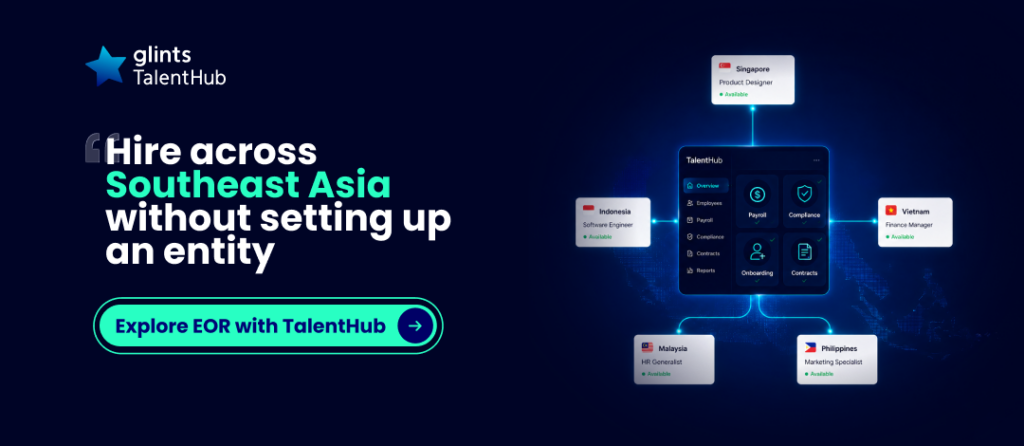
An Employer of Record (EOR) is a third-party organization that legally employs workers on behalf of a company in a specific country.
Instead of opening a legal entity, the EOR for enterprise becomes the official employer on paper. They handle all employment-related responsibilities, including:
- Employment contracts
- Payroll processing
- Tax compliance
- Statutory benefits
- Local labor law adherence
Meanwhile, the enterprise continues to manage the employee’s daily tasks, performance, and overall role within the organization.
Common Enterprise EOR Use Cases
Enterprise EOR services can support several workforce scenarios.
| Use case | How an EOR can help |
|---|---|
| New market entry | Employ an initial local team before establishing an entity |
| Distributed hiring | Hire specialized employees in countries without company entities |
| Market validation | Test commercial demand before making a larger investment |
| Entity transition | Maintain employment during an entity setup or restructuring |
| Merger or acquisition | Support selected employees while employment structures are consolidated |
| Remote hiring | Employ remote professionals according to local requirements |
| Talent retention | Retain an employee who relocates to a supported country |
| Regional expansion | Coordinate hiring, payroll, and compliance across several countries |
When to Use EOR for Enterprise
Here’s a scenario when larger companies use EOR:
1. Expanding Into New Markets Quickly
When speed is critical, EOR allows enterprises to hire in new countries within days. This is especially useful for testing market opportunities without committing to a full legal setup.
2. Hiring Talent in Multiple Countries Simultaneously
If your hiring needs are spread across different regions, setting up entities in each country is inefficient. EOR enables centralized hiring across borders without the complexity of managing multiple legal structures.
3. Testing Market Viability Before Full Investment
Before establishing a permanent presence, enterprises can use EOR to build a small local team, validate demand, and assess long-term potential.
4. Supporting Remote and Distributed Teams
As remote work becomes standard, enterprises often need to hire talent regardless of location. EOR makes it easy to employ remote workers legally in their home countries.
5. Managing Short-Term or Project-Based Hiring
For temporary roles, project-based work, or contract-to-hire setups, EOR provides flexibility without long-term legal commitments.
6. Navigating Complex Compliance Environments
In countries with strict or frequently changing labor laws, EOR helps reduce legal risks by ensuring full compliance with local regulations.
7. During Mergers, Acquisitions, or Restructuring
EOR can act as a bridge solution to maintain employment continuity while legal entities are being established, merged, or restructured.
How EOR Works in an Enterprise Setup
For enterprise organizations, EOR is typically integrated into existing HR and operations workflows.
Here’s how the process looks:
- You identify talent Candidates are sourced internally or through partners
- EOR drafts compliant contracts Contracts align with local labor laws and company policies
- Employee onboarding The EOR officially hires and onboards the employee
- Payroll and compliance management Salaries, taxes, and benefits are handled locally
- Ongoing HR support Leave, termination, and compliance updates are managed
Enterprise EOR Versus Independent Contractors
Hiring an independent contractor can appear faster and less expensive than employing someone through an EOR. However, contractor status depends on the actual working relationship, not only the agreement’s title.
A worker may be considered an employee if the company controls how, when, and where the work is performed or if the individual functions like a regular member of the organization.
Misclassification can expose a company to:
- Unpaid employment benefits
- Tax liabilities
- Social contribution liabilities
- Penalties
- Employment claims
- Intellectual property disputes
- Reputational damage
An EOR may be more suitable when the role has the characteristics of regular employment.
How Much Does Enterprise EOR Cost?
Enterprise EOR costs vary by country, employee headcount, salary, benefits, currency, and service scope.
The total cost may include:
- The employee’s gross salary
- Employer taxes and statutory contributions
- Mandatory employee benefits
- Supplementary benefits
- The EOR service fee
- Payroll or banking charges
- Foreign exchange costs
- Onboarding fees
- Security deposits
- Offboarding or termination costs
- Immigration support where available
- Optional HR or recruitment services
Enterprises should compare total employment cost rather than only the advertised monthly fee.
You can review the current Glints TalentHub pricing or request a country specific proposal based on your workforce plan.
How Glints TalentHub Supports Enterprise Global Hiring
Enterprise hiring becomes more complex when talent acquisition, payroll, compliance, onboarding, and employee support are handled by separate vendors.
Glints TalentHub brings recruitment and Employer of Record support into one connected solution. Companies can source, hire, onboard, pay, and manage professionals across international markets without building every local employment process internally.
This connected model helps reduce vendor fragmentation while giving HR, Legal, Finance, and business teams greater visibility across the employment lifecycle.
Explore Glints TalentHub solutions for enterprises or speak with a hiring expert to develop a workforce plan for your target markets.