




Small businesses increasingly need access to skills beyond their home market, but international employment creates responsibilities that lean HR and finance teams may not be equipped to manage alone.
An Employer of Record, or EOR, gives your business a practical way to employ professionals in another country without immediately establishing your own local entity. The EOR becomes the employee’s legal employer and manages responsibilities such as the employment contract, payroll, statutory contributions, benefits, and local employment administration. Your company continues to manage the employee’s role, objectives, workload, and performance.
For a small business, this model can reduce administrative pressure and make expansion more flexible. However, an EOR is not automatically the right choice for every situation. Your expected headcount, target country, employment costs, timeline, and long term plans should all inform the decision.
What is an Employer of Record?
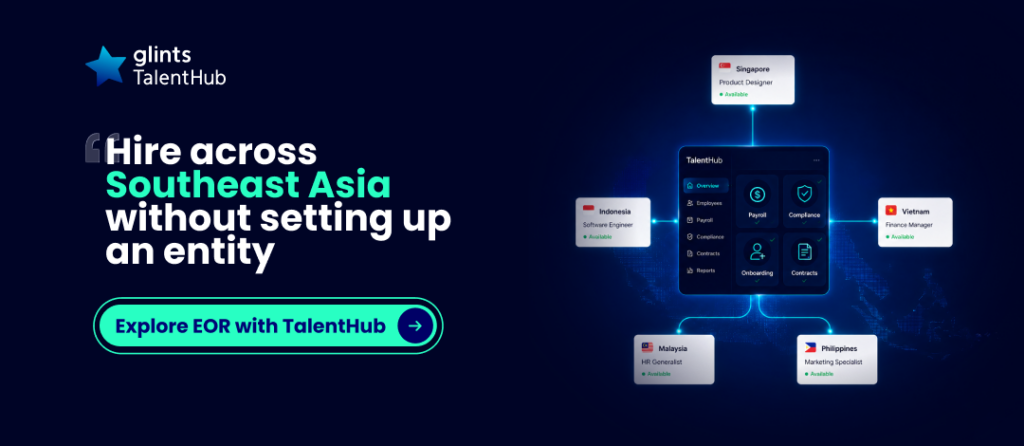
An Employer of Record (EOR) is a third-party provider that legally employs talent on your behalf in another country.
Instead of setting up a local entity, you can hire employees in new markets while the EOR handles payroll, employee contract, and statutory benefits.
Partnering with EOR helps SMB’s to focus on growing companies and let the EOR handle all the complexity of the legal side.
Why SMEs Need an Employer of Record
For small and growing businesses, hiring is rarely just about filling a role. It’s about doing it fast, staying within budget, and making sure every hire actually moves the business forward. An Employer of Record helps you solve all three at once.
1. Access to Global Talent
When you limit hiring to your local market, you’re also limiting your options. With an EOR, you can tap into talent across regions like Southeast Asia where there’s strong expertise in tech, marketing, operations, and customer support.
This means you’re no longer competing in one saturated market. You can find candidates with the right skills, experience, and mindset without being constrained by geography.
2. More Cost Effective
Hiring locally in high-cost markets can quickly stretch your budget, especially for SMBs where every dollar counts. EOR allows you to access equally capable talent in more cost-efficient markets without compromising on quality.
You also avoid large upfront costs like entity setup, legal fees, and administrative overhead. Instead, you get a predictable monthly cost that makes financial planning much easier.
3. Stay Focused on Business Growth
Managing compliance, payroll, contracts, and local labor laws across different countries can easily take up time you don’t have.
An EOR takes these operational burdens off your plate, so you can focus on what actually drives growth. Building your product, serving customers, and scaling your team strategically instead of getting stuck in admin work.
4. Faster and More Efficient Hiring
Speed matters, especially when you’re competing for talent or trying to hit growth targets.
Setting up an entity can take months, but with an EOR, you can hire and onboard talent in just a few days. This shorter hiring cycle means you can move quickly on opportunities and avoid losing strong candidates due to delays.
EOR vs Setting Up an Entity: What Makes More Sense for SMBs?
| Factor | EOR | Local Entity |
| Setup time | A few days to 1 week | 2 to 4 months |
| Upfront cost | Minimal | High (legal, admin, setup fees) |
| Compliance management | Handled by provider | Fully your responsibility |
| Flexibility | High | Lower (harder to exit or adjust) |
| Best for | Testing markets, quick scaling | Long-term, large-scale operations |
How to Choose an EOR Provider for Your Small Business
The right provider should fit your target markets, internal resources, and employee needs. Consider the following criteria before signing an agreement.
1. Relevant Country Expertise
Confirm that the provider can support the countries where you intend to employ people. Ask whether it operates through its own entities or third party partners and who will support your employees locally.
2. Transparent Pricing
Request a complete breakdown of service fees, deposits, statutory costs, benefits, foreign exchange charges, implementation fees, and termination costs.
3. Localised Employment Contracts
The provider should prepare contracts that reflect applicable local requirements. Avoid relying on one standard contract for every country.
4. Payroll and Statutory Administration
Confirm how payroll is calculated, reviewed, funded, and processed. Ask how the provider manages tax withholding, employer contributions, payslips, and annual reporting.
5. Employee Benefits
Check which benefits are legally required, which benefits are optional, and whether the provider can offer packages that are competitive in the local market.
6. Employee Support
Your employees should have a clear contact for questions about payroll, leave, benefits, expenses, and employment documents.
7. Onboarding and Offboarding Support
Ask what documentation is required, how long onboarding normally takes, and how resignations or terminations are managed.
8. Data Protection and Security
The provider will handle personal, employment, banking, and payroll information. Review its security standards, privacy practices, access controls, and data processing terms.
9. Recruitment Capabilities
Some providers begin supporting the company only after a candidate has been selected. If your small business also needs help finding professionals, look for a partner that can connect talent acquisition with employment, payroll, and compliance support.
Employing Talent Across Southeast Asia
Southeast Asia gives growing businesses access to professionals across technology, marketing, finance, operations, customer support, and other business functions.
However, the region is not one uniform employment market. Salary expectations, payroll schedules, statutory contributions, leave entitlements, probation rules, benefits, and termination requirements differ across countries.
A locally experienced partner can help your business understand these differences and create employment packages that are appropriate for each market.
Explore resources for employing talent across Southeast Asia.
Why Southeast Asia Is a Strong Starting Point
If you’re exploring global hiring, Southeast Asia stands out for a few reasons:
- A growing pool of skilled professionals across tech, marketing, operations, and customer support
- Competitive salary benchmarks compared to more mature markets
- Strong English proficiency in many roles
- Increasing experience working with international teams
This makes it easier for SMEs to build capable teams without overstretching budgets.
Final Thoughts
If you’ve been holding back on global hiring because it feels too complex or risky, you’re not alone. Many SMEs face the same challenge.
EOR removes the biggest barriers by giving you a simple, compliant, and scalable way to hire internationally. Instead of spending months setting up infrastructure, you can focus on what actually drives growth which is building a strong team.
If your goal is to move fast, stay lean, and access better talent, EOR is one of the most practical ways to get there.
This article is brought to you by Glints TalentHub. Leading companies are actively building their borderless teams in Southeast Asia, Taiwan, and beyond. However, the prospect of going borderless can be daunting due to complex regulations and cultural ambiguities. With Glints TalentHub, you’ll have a dedicated team of in-market legal, HR, and talent experts by your side at every step of the way.
Glints TalentHub offers an end-to-end, tech-enabled talent solution that encompasses talent acquisition, EOR, and talent development. We empower businesses to leverage the strengths of regional talent efficiently to build high-performing, cost-efficient teams.
Schedule a no-obligation consultation with our experts to receive a tailored proposal today!