
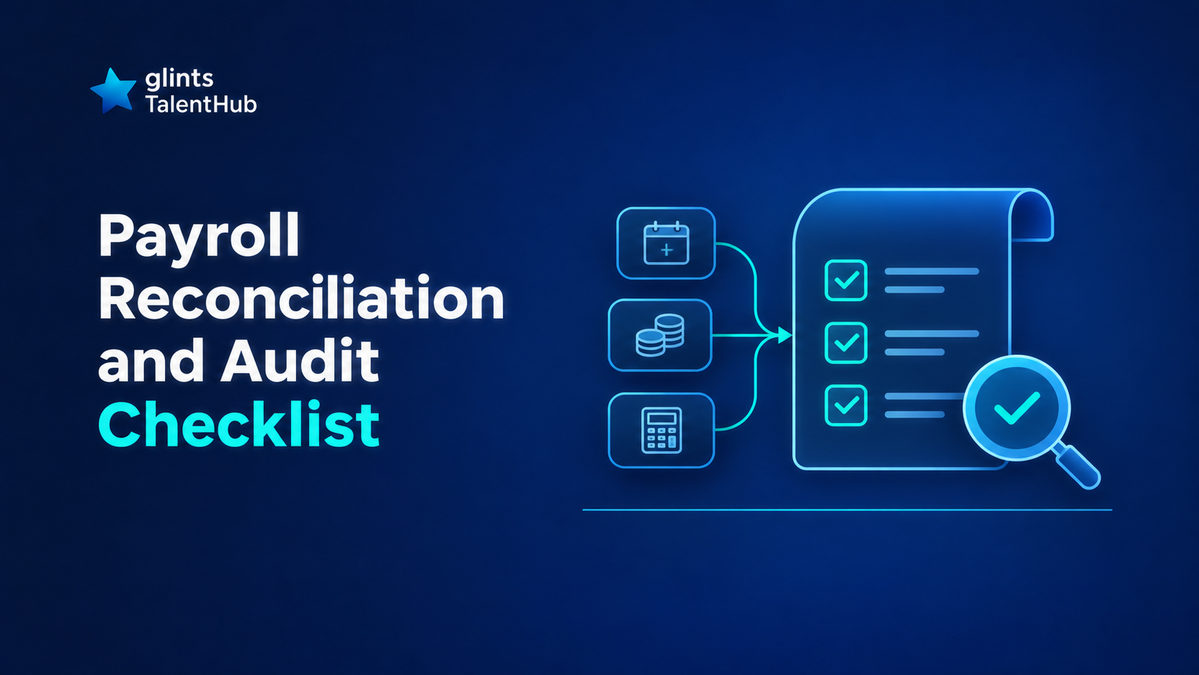
Payroll reconciliation proves that gross pay, employee deductions, employer costs, net payments, accounting entries and statutory submissions agree. For a multi-country team, complete the control in each local currency before translating totals for group reporting. Every payroll should produce four matches: source data to payroll, gross to net, register to bank and register to ledger, plus evidence that statutory amounts were calculated, paid and filed.
One Singapore employee earning SGD 10,000 can expose a weak control. Applying the 2026 CPF rate to the full salary instead of the SGD 8,000 Ordinary Wage ceiling would overstate both the deduction and employer cost. A total-only review may miss the error if another adjustment offsets it. This guide shows how to reconcile each payroll line, close the month and prepare evidence for an annual audit.
What Is Payroll Reconciliation?

Payroll reconciliation is the process of comparing approved employee inputs, payroll calculations, payments, accounting records and statutory records to identify and resolve differences.
It is different from payroll processing, which calculates and pays employees. Reconciliation tests whether those outputs are complete, accurate and recorded in the correct period. A payroll audit goes further by assessing whether controls were designed properly and operated consistently across multiple cycles.
Four Matches Prove That Payroll Is Complete
A payroll total is not reconciled merely because the bank file equals net pay. Multi-country teams need four linked controls, performed in source currency.
| Control | Records compared | What a difference may mean | Evidence to retain |
| Inputs to register | HR master data, attendance, approved changes and payroll register | Missing joiner, duplicate bonus, wrong salary or unapproved deduction | Dated input file, approvals and exception log |
| Gross to net | Earnings, employee deductions and net pay | Wrong contribution base, rate, ceiling, tax treatment or rounding | Employee-level register and independent recalculation |
| Register to bank | Approved net pay and completed bank transactions | Stale bank file, rejected payment or unauthorised change | Approved file, payment report and bank confirmation |
| Register to ledger | Gross pay, employer costs, liabilities, clearing accounts and journal | Mapping, posting, entity, period or cost-centre error | Final journal, GL extract and signed tie-out |
| Statutory three-way match | Payroll calculation, amount paid and return or contribution record filed | Underpayment, late payment, incomplete filing or employee-population mismatch | Return, payment receipt and authority acknowledgement |
Perform the first three checks before releasing funds where possible. Complete the bank, ledger and statutory checks after payment. This adds operational depth to the broader requirements in TalentHub’s global payroll compliance guide.
Southeast Asian Controls Must Stay Local
Global teams can standardise the evidence and sign-off process, but not the statutory calculation. Coverage, contribution bases, rates, ceilings, rounding and filing systems remain country-specific.
| Market | Statutory records to reconcile | Primary control source | Evidence to obtain |
| Singapore | CPF contribution detail and applicable employment-income records | CPF Board | Contribution detail, payment confirmation and submission acknowledgement |
| Malaysia | EPF contribution schedule and Form A; separate SOCSO, EIS and tax records where applicable | KWSP/EPF | Employee schedule, Form A, payment receipt and portal status |
| Indonesia | BPJS Ketenagakerjaan and BPJS Kesehatan participant, wage and contribution records; applicable tax records | BPJS Ketenagakerjaan | SIPP detail, payment code, receipt and participant reconciliation |
| Philippines | SSS, PhilHealth, Pag-IBIG and applicable BIR payroll records | SSS | Employee list, payment reference, receipt and posting confirmation |
| Vietnam | Compulsory social, health and unemployment insurance records; applicable personal income tax records | Vietnam Social Security | Employee schedule, declaration, payment evidence and portal result |
| Thailand | Social Security Office contribution records and Revenue Department withholding records | [VERIFY: confirm the current official SSO employer portal URL and the precise 2026 acknowledgement documents before publication] | Employee schedule, contribution submission, payment receipt and portal status |
The control owner should record the rule version or official schedule used for each pay period. A report generated by the payroll system is not independent proof that the authority received the same population and amount.
A Singapore Gross-to-Net Reconciliation Example
Assume a Singapore citizen aged 55 or below receives SGD 10,000 in Ordinary Wages in one month, with no Additional Wages. The example includes a SGD 200 voluntary deduction and excludes other possible levies or payroll items so that the CPF reconciliation remains visible.
According to the CPF Board, from 1 January 2026 the full rates for this employee category are 17% employer and 20% employee. The Ordinary Wage ceiling is SGD 8,000.
- CPF-applicable Ordinary Wages:
min(SGD 10,000, SGD 8,000) = SGD 8,000. - Employee CPF:
20% × SGD 8,000 = SGD 1,600. - Employer CPF:
17% × SGD 8,000 = SGD 1,360. - Net pay:
SGD 10,000 − SGD 1,600 − SGD 200 = SGD 8,200. - Total employer payroll cost in this simplified example:
SGD 10,000 + SGD 1,360 = SGD 11,360. - CPF payable to the CPF Board:
SGD 1,600 + SGD 1,360 = SGD 2,960.
The journal should debit salary expense SGD 10,000 and employer CPF expense SGD 1,360. Credits should total SGD 11,360: net pay clearing SGD 8,200, voluntary deductions payable SGD 200, employee CPF payable SGD 1,600 and employer CPF payable SGD 1,360.
The bank file must equal SGD 8,200. The CPF payment and submission must equal SGD 2,960. The net-pay and CPF liabilities should clear when paid.
Reconcile Every Country in Source Currency First
A local payroll can be correct while the group report shows a variance caused by exchange rates. Reconcile the payroll register, bank payments, statutory records and local ledger in SGD, MYR, IDR, PHP, VND or THB first.
Translate only the reconciled local totals. Record the exchange-rate source, rate date and accounting policy used. Post translation differences to the designated foreign-exchange account rather than forcing the payroll control to balance in the reporting currency.
This separates three issues that require different owners: payroll calculation errors, payment or posting errors, and foreign-exchange movements. It also prevents a group-level rounding adjustment from hiding a local employee or statutory discrepancy.
Monthly Payroll Reconciliation Checklist
- Freeze the approved employee population and explain every joiner, leaver and transfer.
- Match salary, overtime, leave, bonuses and deductions to dated approvals.
- Compare the current register with the prior cycle by country, entity, pay component and employee.
- Recalculate material or changed gross-to-net cases independently, including ceilings and employee eligibility.
- Confirm the approved net-pay total equals the bank file before release.
- Check completed bank transactions and investigate rejected, duplicated or altered payments.
- Tie gross pay, employer costs, deductions, liabilities and net-pay clearing to the payroll journal.
- Reconcile each statutory item three ways: calculated, paid and filed.
- Clear or explain every payroll liability and suspense-account balance.
- Record each difference, owner, correction, affected period and closure evidence.
- Obtain preparer and reviewer sign-off with timestamps.
- Archive the final register, approvals, bank evidence, journal, filings, receipts and exception log together.
Where payroll is outsourced, these controls still belong in your governance process. TalentHub’s guide to payroll outsourcing risks explains why provider calculation does not replace employer review.
Annual Payroll Audit Checklist
- Reconcile all monthly registers to annual gross pay, deductions, employer costs and net pay.
- Match annual employee totals to required year-end statements and authority records in each market.
- Test a sample containing joiners, leavers, bonuses, unpaid leave, corrections, foreign workers and employees near statutory ceilings.
- Review manual journals, off-cycle payments, negative net pay and reopened payroll periods.
- Confirm old reconciling items were resolved rather than carried forward.
- Review access rights, bank-detail changes and separation between preparation, approval and payment release.
- Confirm current rate tables and rule versions were applied from their effective dates.
- Inspect whether every filing has a payment receipt and authority acknowledgement.
- Review provider service reports and unresolved payroll queries.
- Document control failures, root causes, remediation owners and target dates.
Common Mistakes Hide Behind Balanced Totals
Reviewing aggregates only: Two employee-level errors can offset each other. Test individual records as well as totals.
Combining employee and employer contributions: Employee deductions reduce net pay. Employer contributions increase payroll cost. Mixing them breaks both the gross-to-net calculation and the journal.
Treating submission as payment: A return may be filed while payment remains pending, or a payment may clear without the correct employee schedule.
Translating before reconciling: Different rates and dates create artificial differences. Complete the local control first.
Using the payroll export as its own proof: An independent record must confirm the result, such as a bank transaction, GL extract or authority acknowledgement.
If you operate a small payroll in one market with a capable local specialist, keep the work in-house and use this checklist. If you have several Southeast Asian entities, providers or manual journals and cannot produce one signed evidence pack per country each month, use a regional payroll provider while retaining internal approval and reconciliation ownership.
FAQ About Payroll Reconciliation
How Often Should Payroll Be Reconciled?
Reconcile payroll every pay period before payment and complete the bank and ledger tie-outs after payment. Perform a full close monthly and a cumulative review before each applicable statutory or year-end submission. The filing frequency differs by Southeast Asian market, so the country calendar should control the statutory review dates.
What Reports Are Needed for Payroll Reconciliation?
At minimum, obtain approved employee inputs, the employee-level payroll register, prior-period variance report, bank file, completed payment report, payroll journal, GL extract, statutory submission, payment receipt and authority acknowledgement. Keep an exception log linking each difference to its correction and reviewer approval.
What Is the Difference Between Payroll Reconciliation and a Payroll Audit?
Reconciliation is a recurring control that matches one payroll’s calculations and outputs across records. A payroll audit examines controls, access, classifications, compliance and evidence across a longer period. Clean monthly reconciliations make an audit faster, but they do not replace an independent review of whether the process operated properly.
What Should You Do When Payroll Does Not Match the General Ledger?
Identify the first pay period and account where the difference arose. Classify it as timing, mapping, calculation, posting or foreign exchange. Correct the payroll record or journal through an approved process, retain the original and corrected entries, and verify that the affected liability or clearing account subsequently closes.
Can Payroll Software Reconcile Payroll Automatically?
Software can compare totals and flag differences, but it cannot prove that an input was authorised, a worker was correctly covered or an authority accepted a filing. Human review remains necessary for exceptions, local rule changes and unusual employee cases. The global payroll glossary provides further context on centralised systems and local expertise.
Build a Reconciliable Southeast Asian Payroll Process
If your company has entities in Singapore, Malaysia or Indonesia, you can run these controls internally or use a provider for the agreed calculation and reporting work. Glints TalentHub’s payroll outsourcing service prepares gross-to-net calculations and payroll reports for your review; your team should still approve each run and retain the reconciliation evidence.
Key Takeaway
Do not approve a multi-country payroll because one grand total looks reasonable. Reconcile each country in source currency, prove the four operational matches, then confirm that every statutory calculation equals both the payment and filed record. If your team cannot reproduce that chain months later, the payroll is not audit-ready.