




Hiring in Vietnam sounds simple, until you actually try to do it without a local entity. What starts as a straightforward plan to recruit talent can quickly turn into a maze of labor laws, payroll setup, tax compliance, and mandatory statutory requirements.
Instead of focusing on finding the right candidates, you end up dealing with legal processes that slow everything down.
For companies that want to move fast, setting up a legal entity just to hire one or two employees often feels unnecessary and time-consuming. The risk of non-compliance also adds another layer of concern, especially when you’re not fully familiar with local regulations.
This is where an Employer of Record (EOR) becomes a practical solution, allowing you to handle hiring in Vietnam without the hassle of entity setup, while staying fully compliant from day one.
What Is an Employer of Record (EOR) in Vietnam?
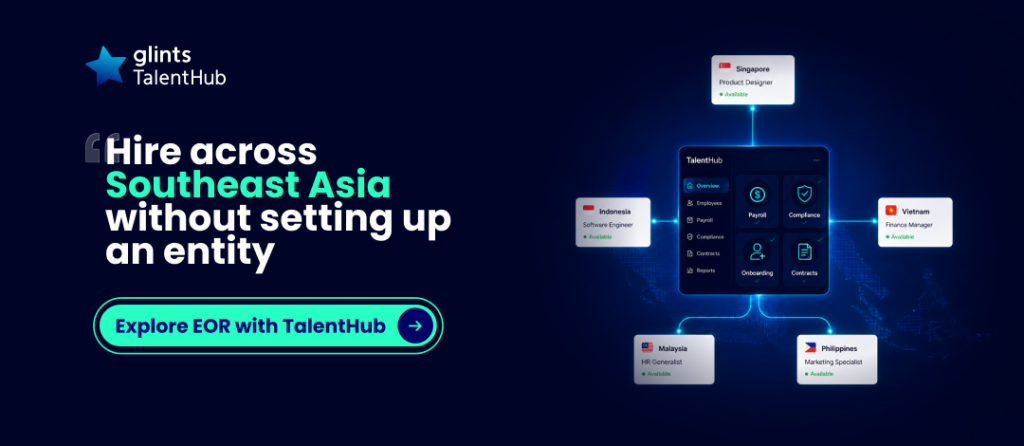
An Employer of Record (EOR) in Vietnam acts as the legal employer for your hires, so you can operate without setting up a local entity. While you manage daily work and performance, the EOR ensures full compliance with local regulations.
This includes adherence to the Labor Code 2019 (Law No. 45/2019/QH14), the Law on Social Insurance 2014, and personal income tax requirements, areas that can be complex without local expertise.
Is Employer of Record Legal in Vietnam?
Yes, using an Employer of Record in Vietnam is legal.
However, it must be structured correctly.
Vietnam does not explicitly use the term employer of record in its labor laws. Instead, EOR services operate through local employment and outsourcing frameworks, where the EOR is registered as the legal employer and complies with all statutory obligations.
A compliant EOR in Vietnam will:
- Issue locally compliant employment contracts
- Register employees with social insurance authorities
- Handle personal income tax (PIT) filings
- Ensure adherence to Vietnam’s Labor Code
The key is working with a provider that has a registered local entity and deep understanding of Vietnam’s employment regulations.
Why Hire Talent in Vietnam?
Vietnam has become an increasingly attractive destination for global hiring. Here’s why:
1. Growing Talent Pool
Vietnam boasts a large, educated workforce, particularly in fields like technology, manufacturing, and customer support. The country produces a steady stream of skilled graduates each year.
2. Competitive Labor Costs
Compared to many other countries in Asia, Vietnam offers lower labor costs without compromising on quality, making it ideal for startups and scaling businesses.
3. Strong Economic Growth
Vietnam’s economy has shown consistent growth over the past decade, supported by strong exports, foreign investment, and government reforms.
4. Strategic Location
Located in Southeast Asia, Vietnam provides easy access to major markets such as China, Singapore, and Thailand, making it a strategic hub for regional expansion.
Key Employment Regulations in Vietnam
Hiring in Vietnam comes with specific statutory requirements that employers must follow.
1. Employment Contracts
All employees must have a written labor contract. Contracts can be:
- Indefinite-term
- Fixed-term (up to 36 months)
2. Working Hours and Overtime
- Standard working hours: up to 48 hours per week
- Overtime is regulated and capped annually
- Overtime pay ranges from 150% to 300% depending on timing
3. Minimum Wage
From 1 January 2026, the monthly minimum wages are:
- Region I: VND 5,310,000
- Region II: VND 4,730,000
- Region III: VND 4,140,000
- Region IV: VND 3,700,000
4. Social Insurance Contributions
Employers and employees must contribute to mandatory insurance schemes:
- Employer contribution: ~17.5% (Social Insurance) + 3% (Health Insurance) + 1% (Unemployment Insurance)
- Employee contribution: ~8% (Social Insurance) + 1.5% (Health Insurance) + 1% (Unemployment Insurance)
These contributions are calculated based on salary (with caps depending on regulations).
5. Personal Income Tax (PIT)
Vietnam applies progressive personal income tax rates to employment income earned by tax residents.
For the 2026 tax year, the five monthly taxable income brackets are:
- Up to VND 10 million: 5%
- Over VND 10 million to VND 30 million: 10%
- Over VND 30 million to VND 60 million: 20%
- Over VND 60 million to VND 100 million: 30%
- Over VND 100 million: 35%
The monthly personal deduction is VND 15.5 million. An additional deduction of VND 6.2 million may apply for each registered dependent.
Nonresident employees are generally taxed at 20% on Vietnam sourced employment income.
Tax residence, income source, deductions, exemptions, and applicable agreements can affect the final calculation. Employers should assess each employee’s circumstances before running payroll.
6. Employee Leave Entitlements
The following is employee leave in Vietnam:
- Annual leave: minimum 12 days per year
- Public holidays: around 11 days annually
- Additional leave may apply based on tenure or working conditions
7. Work Permits for Foreign Employees
Foreign hires typically require:
- A valid work permit
- Employer sponsorship
- Compliance with quota and eligibility requirements
Hiring Talent in Vietnam with Glints TalentHub
Vietnam offers a compelling mix of talent quality, cost efficiency, and growth potential. But hiring here requires careful navigation of local regulations.
An Employer of Record simplifies the process by handling compliance, payroll, and legal employment, so you can focus on building your team.
If you’re exploring hiring in Vietnam and want a faster, compliant way to get started, partnering with the best EOR in Vietnam like Glints TalentHub can make all the difference.
Frequently Asked Questions About EOR in Vietnam
Can a foreign company hire employees in Vietnam without an entity?
A foreign company generally cannot employ local workers directly without an appropriate registered presence. Depending on the position and working arrangement, it may be possible to hire through a properly structured local EOR provider.
How much does an EOR cost in Vietnam?
EOR pricing may include a setup fee, monthly fee, employee deposit, payroll charges, foreign exchange costs, benefit expenses, and termination support.
Request a complete cost breakdown before selecting a provider. The lowest monthly fee may not represent the lowest total employment cost.
How quickly can an employee start through an EOR?
The timing depends on contract preparation, employee documentation, payroll registration, insurance registration, background checks, and work permit requirements.
A local employee with complete documents may be onboarded more quickly than a foreign employee who needs immigration approval.
Does an EOR find candidates?
Some EOR providers only employ candidates selected by the client. Other providers, including Glints TalentHub, can support both recruitment and EOR services.
Using one provider for both stages can make the process more efficient and reduce handovers.
Who manages the employee’s daily work?
Your company normally assigns work, sets goals, and manages performance. The EOR handles the legal employment relationship and related administration.
The division of responsibilities should be documented clearly in the service agreement.
Can an EOR sponsor foreign workers?
Potentially, but eligibility depends on the position, the worker’s qualifications, the provider’s structure, and current work permit requirements.
Work permit feasibility should be assessed before making a final employment offer.
Can EOR employees transfer to our own entity later?
Yes, subject to Vietnamese employment requirements.
The transfer must be managed carefully. The existing employment relationship may need to be ended correctly before the employee signs a new contract with your entity.
Is an EOR the same as a PEO?
No. An EOR becomes the legal employer of the worker through its local structure. A Professional Employer Organization usually supports companies that already have an entity capable of employing workers directly.