
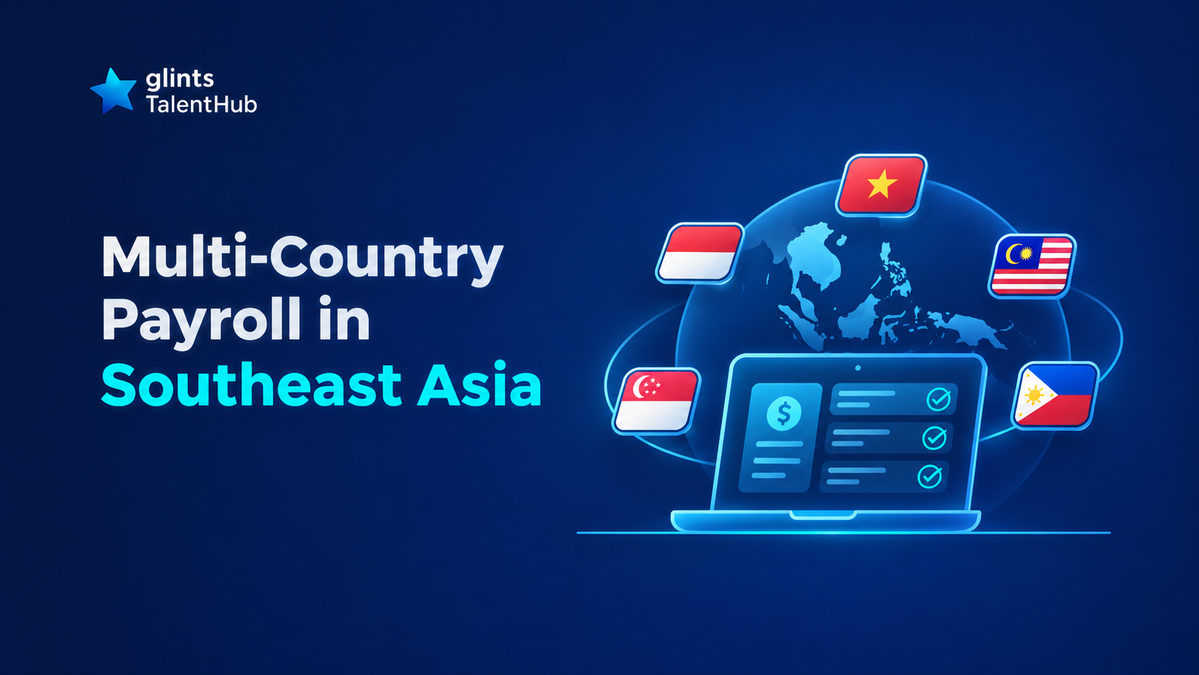
Multi-country payroll in Southeast Asia works best as one control framework with five local execution calendars. Standardise employee data, input cut-offs, approval evidence, reporting fields and reconciliation. Keep statutory calculations, filing formats, payment timing, local bank access and country exceptions under local ownership. A single platform can coordinate the work, but it cannot turn five legal systems into one payroll.
A regional payroll can appear complete while one country is still unfunded, a filing remains unsubmitted or a bank file is waiting for approval. That is the real risk: the consolidated report says “closed”, but the employee or authority has not received the money. This operating model shows how to define ownership from employee change through payment, filing and regional reporting.
What Is Multi-Country Payroll?

Multi-country payroll is the coordinated process of calculating, approving, funding, paying and reporting employee compensation in two or more countries.
It is different from payroll compliance. Compliance defines what each employer must calculate, withhold, submit and retain. Multi-country payroll management decides who owns each action, when it happens, what evidence closes it and how local results become one regional report.
It also differs from an employer of record. Payroll outsourcing usually supports employees hired through your own entity. An employer of record becomes the legal employer where you do not have an employing entity.
Standardise Controls, Not Country Rules
The regional team should standardise six things:
| Standardise Regionally | Keep Local |
| Employee master-data fields and change forms | Tax status, statutory identifiers and contribution treatment |
| Input categories and monthly cut-off logic | Local pay frequency and statutory calendar |
| Maker-checker approval stages | Gross-to-net calculation and payslip format |
| Evidence required to close each task | Authority portals, filing formats and local language |
| Group chart-of-accounts mapping | Local bank file and authorised signatories |
| Reporting currency and FX policy | Salary and statutory payments in local currency |
The safest data model has one named owner for each field. HR owns employment status and agreed compensation. Managers approve variable inputs. Local payroll validates statutory treatment. Finance approves funding and ledger mapping. Treasury releases bank payments. The regional payroll owner confirms that payment and filing evidence exists before marking the country complete.
A provider can perform several steps, but “provider owns payroll” is not a sufficient control description.
Five Markets Need Five Close Calendars
The table below shows representative timing constraints, not every payroll obligation. Country owners should maintain the complete local calendar.
| Market | Local Timing To Design Around | Main Local Systems | Regional Control Implication |
| Singapore | Employees covered by the Employment Act must generally be paid at least monthly and within seven days after the salary period. CPF is due at month-end; enforcement applies if unpaid after the 14th of the following month. AIS employment-income reporting is due by 1 March. | CPF EZPay, IRAS/myTax Portal, local bank | Do not treat salary payment, CPF and annual reporting as one completion status. |
| Indonesia | Withheld PPh 21 is generally paid by the 10th and reported by the 20th of the following month. [VERIFY: confirm the current payment cut-offs for each applicable BPJS programme with an Indonesian payroll specialist before publication.] | Coretax/DJP, BPJS Kesehatan, BPJS Ketenagakerjaan, local bank | Retain separate evidence for tax payment, tax return and each BPJS submission. |
| Malaysia | In Peninsular Malaysia and Labuan, the wage period cannot exceed one month and wages are generally due by the seventh day after it ends. EPF and monthly tax deductions are due by the 15th of the following month. Sabah and Sarawak have separate labour ordinances. | KWSP i-Akaun, PERKESO ASSIST, HASiL, local bank | Location is a payroll field, not merely an address field. It determines the applicable labour framework. |
| Philippines | Wages are generally paid at least every two weeks or twice monthly, with intervals not exceeding 16 days. Regular-employer SSS contributions are due by the last day of the following month; PhilHealth uses employer-number-based payment windows. | My.SSS, PhilHealth EPRS, Pag-IBIG and BIR systems, local bank | A twice-monthly salary cycle can feed one month-end regional report, but must not be forced into one monthly payday. |
| Vietnam | Monthly salary must be paid on an agreed, recurring date. Employees receive a pay statement, and employers bear bank-account opening and salary-transfer fees when paying through an employee’s account. Under the Social Insurance Law effective July 2025, monthly employer contributions are due by the last day of the following month. | Vietnam Social Security, tax systems and local bank | Preserve the agreed local payday and keep bank costs outside employee deductions. |
Build the regional calendar backwards from each payday and statutory deadline. Include local holidays, bank cut-offs, funding lead time, approval windows and an escalation point. Use one template, but allow different dates.
Data Ownership Must Follow the Change
Every payroll input should carry four attributes: effective date, source, approver and country treatment.
For example, HR may record a promotion effective 1 November, but payroll should not process the new salary until the authorised compensation record is attached. If the change arrives after the local cut-off, the country owner should record whether it moves to the next cycle or creates an approved off-cycle payment.
Protect the maker-checker split. The person changing bank details should not be the sole person approving the bank file. The person calculating net pay should not be the only person reconciling it.
For more detail on delivery choices, compare payroll outsourcing with an in-house payroll team.
Multi-Currency Reporting Needs One Written FX Rule
Employees, authorities and benefit bodies should be paid in the required local currency through the appropriate local arrangement. Regional management reporting is a separate conversion exercise.
Choose and document:
- The group reporting currency.
- The FX source and rate date used for payroll expense.
- Treatment of funding-rate differences and bank charges.
- Whether prior-period adjustments use the original or current rate.
- Who approves the monthly FX reconciliation.
Do not overwrite local payroll values after conversion. Store local amount, local currency, reporting rate, converted amount and conversion date as separate fields. That preserves an audit trail when finance investigates a variance.
Worked Example: Consolidating Five Payrolls Into USD
Assume a group adopts the following illustrative internal month-end rates, expressed as local-currency units per US dollar. These are not current market rates and must not be used for payment.
| Market | Local Payroll Cost | Illustrative Rate | USD Reporting Amount |
| Singapore | SGD 120,000 | 1.35 | USD 88,888.89 |
| Indonesia | IDR 1,500,000,000 | 15,500 | USD 96,774.19 |
| Malaysia | MYR 300,000 | 4.50 | USD 66,666.67 |
| Philippines | PHP 2,800,000 | 56.00 | USD 50,000.00 |
| Vietnam | VND 2,400,000,000 | 24,000 | USD 100,000.00 |
| Consolidated payroll cost | USD 402,329.75 |
Calculation: local payroll cost ÷ approved reporting rate. The regional report should reconcile the USD 402,329.75 total to five approved local registers, not to five bank debits alone. Bank debits may also contain transfer fees, while statutory payments may leave the account on different dates.
A Seven-Step Payroll Operating Checklist
- Confirm the employing model. Record whether each person is employed by your entity or through an employer of record.
- Create the country calendars. Separate input cut-off, calculation, approval, funding, payday, remittance and filing dates.
- Assign field ownership. Give every employee and variable-pay field one system of record and one accountable owner.
- Define approval evidence. Retain the input file, variance review, approved register, bank authorisation and filing receipt.
- Fund locally. Account for local currency, bank holidays, account access and failed-payment escalation.
- Reconcile before reporting. Match headcount, gross pay, deductions, net pay, employer costs and funding by country.
- Close with evidence. Mark a country complete only after payment and required filing evidence has been received.
This checklist is the bookmarkable control asset. Adapt the dates and authority submissions in a country appendix rather than changing its control structure.
What Employers Get Wrong About Regional Payroll
One deadline replaces five calendars. A common monthly close can coordinate reporting, but it cannot replace local pay and filing dates.
A calculation file proves completion. A register shows what should be paid. It does not prove that employees, authorities or benefit bodies received funds.
Conversion happens inside local payroll. Local payroll records should remain in local currency. Conversion belongs in the reporting layer.
Outsourcing removes employer accountability. Scope varies. Contracts should state who prepares, approves, submits, pays, corrects and stores evidence.
Every country should use the same provider model. A mixed model may be more sensible when you have established entities in some markets and only a small exploratory team in another.
Use a Hybrid Model When Your Footprint Is Uneven
If you have established entities and stable headcount, retain the entities and use in-house or managed payroll with regional controls. If you are testing a market without an entity, an employer of record may be the more practical temporary model. Review the arrangement when headcount, permanence or the need for direct control changes.
The regional standard should apply to both: one data dictionary, one approval policy and one consolidated report, with local execution underneath.
FAQ About Multi-Country Payroll
Can One Payroll System Handle Every Southeast Asian Country?
One platform can coordinate data, approvals and reporting, but country coverage must be tested at task level. Confirm whether it calculates local payroll, produces compliant outputs, supports authority submissions, connects to local banking and retains filing evidence. A country logo on a vendor page does not prove full execution capability.
Do We Need a Different Payroll Calendar for Every Country?
Yes, each country needs a local calendar, even when the group uses one regional close. The local version should include payday, authority deadlines, bank holidays, funding lead times and approval cut-offs. The regional calendar then shows dependencies and exceptions across countries.
How Do Companies Consolidate Payroll Across Multiple Currencies?
Keep each approved payroll register in local currency, map its cost categories to the group chart of accounts, and convert it using one documented reporting-rate policy. Store both values. Reconcile converted reports to local registers before posting the consolidated journal.
What Is the Difference Between Multi-Country Payroll and an EOR?
Multi-country payroll coordinates payment for workers across countries. An employer of record is the legal employer for specified workers. Companies commonly use their own entities with payroll support in established markets and an EOR where they have no entity.
Who Should Own Multi-Country Payroll Data?
HR should own employment and compensation records; managers should approve variable inputs; local payroll should own country calculations; finance should approve funding and accounting; treasury should release payments. A regional payroll owner should control the calendar, evidence standard and consolidated close.
Build One Regional Control Layer Without Flattening Local Payroll
If you already employ staff through local entities, TalentHub’s published payroll outsourcing service covers Singapore, Malaysia and Indonesia. For a five-market footprint, ask which payroll, PEO or EOR model applies in the Philippines and Vietnam, and obtain a country-by-country responsibility matrix before signing.