


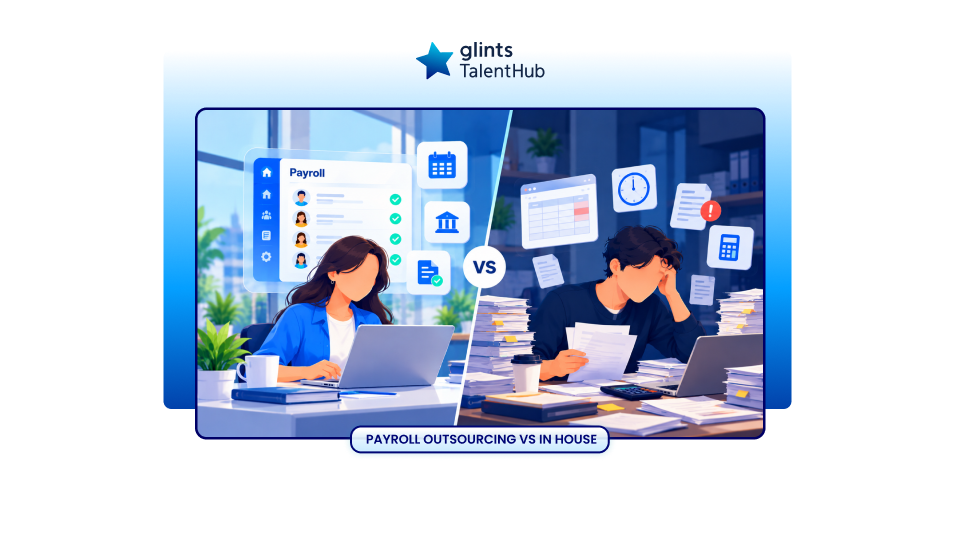
Payroll outsourcing vs in house payroll is a decision about who does the work, what expertise you need and how much capacity your team can commit each month.
With in house payroll, your employees manage the process using payroll software or other tools. With outsourcing, an external provider performs agreed payroll activities while your business supplies employee information, reviews the results and approves payroll.
Both approaches can work well. The better fit depends on your payroll complexity, internal capabilities, service requirements and total operating cost.
If payroll regularly pulls your HR and Finance teams away from other priorities, outsourcing may help. If you already have experienced payroll staff, reliable systems and effective controls, keeping payroll in house may be more practical.
This guide compares the advantages, limitations and costs of each option so you can choose an approach that supports your team.
What Is In House Payroll?
In house payroll means your business manages payroll through its own employees. An HR administrator, finance executive or dedicated payroll team may collect employee updates, calculate salaries, check deductions, prepare payslips and coordinate payments.
Your team also manages applicable payroll reporting, statutory activities and record keeping.
In house payroll does not necessarily mean manual payroll. Businesses can use software to automate calculations and reporting while retaining responsibility for operating the process.
For example, your HR team might approve attendance and salary changes, your payroll specialist processes the calculations, and Finance reviews the payroll summary before releasing payments.
The quality of this model depends on the people, systems and checks behind it.
What Is Payroll Outsourcing?
Payroll outsourcing means engaging an external provider to handle specified payroll activities.
Depending on the agreement, these may include salary calculations, employee deductions, employer contributions, payslips, payroll reports and statutory administration.
Some providers support payments and submissions. Others prepare calculations and reports for your team to act on. Confirm the exact scope before comparing quotations.
Your company generally remains the legal employer. Payroll outsourcing alone does not establish a local employing entity or replace an Employer of Record arrangement.
For a fuller explanation of service scope and the monthly workflow, read the guide to payroll outsourcing.
Payroll Outsourcing vs In House at a Glance
| Area | In house payroll | Payroll outsourcing |
|---|---|---|
| Who processes payroll | Your employees | An external provider handles agreed activities |
| Internal workload | Your team manages preparation, processing, review and administration | Your team still prepares inputs, manages exceptions and approves results |
| Cost structure | Staff time, software, training, backup cover and system upkeep | Provider fees, setup costs, additional charges and retained internal work |
| Operational control | Direct control over processing and priorities | Control through approvals, service scope, deadlines and reporting |
| Payroll expertise | Built internally or obtained through advisers | Available within the provider’s agreed expertise and support scope |
| Handling urgent changes | Depends on internal capacity and system flexibility | Depends on agreed deadlines and arrangements for additional runs |
| Continuity | Requires trained backup staff and documented procedures | Depends on the provider’s staffing, systems and recovery arrangements |
| Data security | Your team manages internal access and system controls | Your team must also assess provider access, transfers and data handling |
| Expansion | May require additional people, software or local expertise | May be supported by the provider, subject to country and service coverage |
Outsourcing changes how payroll is delivered. It still requires an internal owner who understands the process and can challenge unexpected results.
1. Cost: Compare the Full Operating Model
A provider’s monthly fee and a software subscription are not equivalent costs.
Software gives your team tools to run payroll. A service provider performs agreed work. Comparing the two fairly means including the people and activities required under each option.
The Cost of In House Payroll
Your internal cost can include:
- Time spent collecting and checking payroll information.
- Time spent processing calculations and reviewing exceptions.
- Software subscriptions, configuration and integrations.
- Training and access to local payroll advice.
- Backup coverage during leave or staff departures.
- Reporting, reconciliation and employee queries.
- Corrections and additional payment runs.
Allocate staff costs according to the time spent on payroll. If an HR executive spends part of their month on payroll, counting their entire salary would overstate the cost.
Also consider whether saved time would reduce spending or simply create capacity for other work. Both can be valuable, but they have different financial implications.
The Cost of Payroll Outsourcing
Your outsourced cost may include a recurring fee, a charge per employee or a charge per payroll run.
Ask about setup, annual reporting, additional entities, integrations, payment administration, corrections and work outside the standard scope.
Then add the internal time needed to prepare inputs, answer questions, review reports and approve payments.
A useful comparison is:
In house annual cost = allocated staff cost + software + training and advice + backup coverage + other payroll operating costs
Outsourced annual cost = provider fees + setup and additional charges + retained internal staff cost + any retained systems and advice
Keep the scope and time period consistent. Include setup costs in the first year, then compare the expected recurring cost separately.
An Illustrative Cost Comparison
The following figures are hypothetical, expressed in SGD and used only to show the calculation. They are not market benchmarks or Glints TalentHub pricing.
| Annual cost item | In house model | Outsourced model |
|---|---|---|
| Internal payroll work | SGD 12,000 | SGD 4,800 |
| Payroll software | SGD 2,400 | Included in assumed provider fee |
| Training, advice and backup cover | SGD 2,000 | SGD 1,000 |
| Recurring provider fees | Not applicable | SGD 9,600 |
| Initial setup | Not applicable | SGD 1,500 |
| First year total | SGD 16,400 | SGD 16,900 |
| Recurring annual total on these assumptions | SGD 16,400 | SGD 15,400 |
In this example, outsourcing costs slightly more in the first year and less in subsequent years. The decision also depends on service quality and whether the reduction in internal workload is achievable.
Use your own time records and written quotations to build the comparison.
2. Workload: What Will Your Team Still Need to Do?
Outsourcing can reduce processing work, but it does not remove the need for accurate employee information.
Someone inside your business still needs to confirm new joiners, departures, salary changes, commissions, approved overtime and unpaid leave.
Your team also needs to explain unusual movements and approve the final payroll.
If the main bottleneck is collecting attendance from managers, appointing a provider may leave that problem largely unchanged. Improving the approval process could be the first priority.
If the bottleneck is calculating payroll across different locations, preparing reports or resolving technical questions, specialist support may remove more work.
When monthly calculations and repeated checks leave less time for employee support and financial planning, external payroll support can help ease the workload. Glints TalentHub supports payroll calculations, payslips and reporting, while your team retains review and approval.
3. Control: Who Can Make Changes and Approve Payments?
In house payroll gives your team direct access to the processing workflow. This can help when pay arrangements change frequently or reports need extensive customisation.
However, direct access needs clear controls. One employee should not be able to change bank details, approve payroll and release payments without an independent check.
Outsourcing can preserve your approval authority while moving calculations and administration to a provider.
Agree on the following before the first run:
- Who can submit salary and bank account changes.
- Who checks that instructions are authorised.
- Who reviews payroll differences.
- Who approves final amounts.
- Who releases payments and checks their status.
- Who investigates and resolves errors.
Ask how urgent changes are handled after the standard submission deadline. A last minute commission adjustment may require an additional run or fee.
The practical question is whether each model gives you the access, review time and escalation route your business needs.
4. Compliance: Match Expertise to Your Employment Locations
Payroll requirements vary by country. A process designed for one location may need different deductions, contributions, reports or records elsewhere.
An in house team needs the knowledge and support to identify applicable requirements and update its processes when those requirements change.
An outsourced provider may supply local expertise, but the contract should explain whether its work covers calculations, submissions, payments or only selected activities.
For example, Singapore’s Ministry of Manpower requires itemised payslips for employees covered by the Employment Act and specifies the information they must contain. Employers also have record retention duties. A payroll report alone does not necessarily satisfy every requirement.
For each location, document who prepares, reviews, submits and pays each required item. Retain evidence that the activity was completed.
Avoid treating outsourcing as a blanket transfer of legal responsibility. The effect depends on the jurisdiction and arrangement. Obtain local advice where responsibility is unclear.
5. Data Security: Assess the Controls in Both Models
Payroll records contain sensitive information, including salaries, bank details and identification data.
Keeping payroll internally does not automatically make it more secure. Shared passwords, unrestricted spreadsheets and outdated access permissions can create exposure.
Outsourcing adds another organisation to the data flow, making provider checks essential.
Ask both your internal team and prospective providers:
- Who can view or change employee records?
- How are sensitive changes verified?
- How is information transferred and stored?
- What access and activity logs are available?
- Where is data processed, and are other providers involved?
- How are incidents reported and investigated?
- What happens to records when access or the contract ends?
In Singapore, PDPC guidance explains that an organisation engaging a data intermediary should clearly specify the intermediary’s obligations and responsibilities in its written contract.
Compare documented practices and contractual commitments. General claims about security are not enough to assess either approach.
6. Continuity and Growth: Can Payroll Keep Running?
A payroll process can appear reliable while depending heavily on one person’s knowledge.
For an in house model, check whether a trained colleague can complete payroll using current procedures. Confirm that backup staff have the right access and approval permissions.
For an outsourced model, ask who takes over when your usual contact is unavailable, how service disruptions are managed and how urgent issues reach a decision maker.
Expansion adds another test.
A larger team with standard salaries may be easier to administer than a smaller workforce spread across several countries with variable pay. Headcount alone does not show how complex payroll will become.
Check whether the model can support additional entities, locations, pay components and reporting requirements without creating excessive manual work.
When Does In House Payroll Make Sense?
In house payroll may fit your business when you have:
- Experienced staff who can manage the relevant requirements.
- Reliable software and accurate employee records.
- Documented procedures and trained backup cover.
- A need for frequent custom calculations or reports.
- Enough capacity to maintain the process as your business changes.
For example, a business operating in one country with a dedicated payroll team and stable systems may have little reason to replace a process that already works well.
The priority may be improving integrations or approval controls.
When Does Payroll Outsourcing Make Sense?
Outsourcing may be useful when:
- Payroll regularly takes capacity away from employee support or financial work.
- Your team lacks expertise in an employment location.
- Calculations and reports require repeated corrections.
- Payroll depends on one employee with limited backup.
- You need processing support as your workforce expands.
Consider a business whose Finance team manages payroll alongside accounting and cash flow planning. An external provider could take on calculations and report preparation, while Finance retains review and funding responsibilities.
The benefit depends on whether the agreed service removes the work causing the bottleneck.
Can You Combine In House Payroll and Outsourcing?
Yes. A hybrid model divides responsibilities between your team and a provider.
Your HR team might maintain employee records and collect approved changes. The provider calculates payroll and prepares reports. Finance reviews the results and authorises payment.
Another business might retain payroll internally in its main market and appoint providers in locations where it lacks local expertise.
Document the handoffs carefully. Each activity needs one clear owner, a deadline and evidence of completion.
Hybrid payroll works best when responsibilities are explicit and reports can be reconciled across the business.
How to Choose the Right Payroll Model
1. Map the Current Problems
Review recent payroll cycles. Record time spent, corrections, late inputs, employee queries and missed internal deadlines.
Identify whether the main issue is data collection, technical expertise, processing capacity or approval delays.
2. Define the Required Service
List the countries, entities, employee groups, pay components, reports and statutory activities involved.
Separate essential requirements from optional features so providers and internal teams are evaluated against the same scope.
3. Compare Cost and Delivery Quality
Build the full cost comparison and request sample outputs.
Check whether your team can explain an employee’s net pay, reconcile employer costs and trace adjustments to approved instructions.
4. Test the Transition Plan
Before changing models, agree how employee records, opening balances and payroll history will be validated.
Where practical, run a parallel calculation before the first live payroll. Investigate differences and confirm who signs off the transition.
5. Set Review Measures
Track results such as processing time, corrections identified after approval, payment completion and query resolution.
Use these measures to assess whether the model delivers the capacity, accuracy and visibility your team needs.
Reduce Payroll Workload with Glints TalentHub
If payroll keeps taking time away from supporting employees and managing your business, it may help to delegate recurring calculations and report preparation.
Glints TalentHub’s payroll service supports salary calculations, applicable tax and statutory contribution calculations, payslip preparation, reporting and local payroll guidance. Your company remains the employer, and your team reviews and approves the results before payment through the agreed arrangement.
Share your headcount, employment locations and current payroll challenges to discuss the scope you need. Confirm country availability, filing responsibilities and payment arrangements as part of your quotation.