
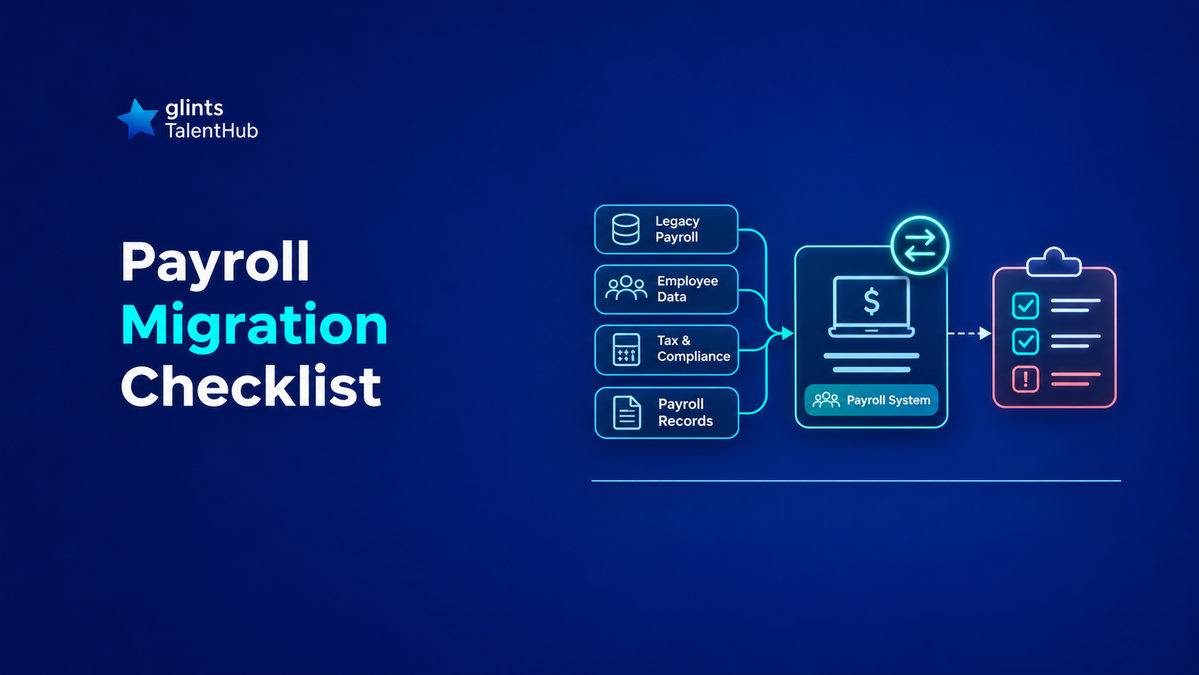
A payroll migration should pass six gates before the replacement system pays anyone: scope, audited data, mapped rules, configured integrations, an explained parallel run and signed go-live approval. The safest default is to delay cutover if any unexplained variance affects gross pay, net pay, bank details or statutory balances. A completed task list alone is not proof that payroll is ready.
A payroll file can import successfully while carrying the wrong contribution basis, duplicated deduction or outdated bank account. Those defects may still produce numbers that look plausible. The risk is highest when regional teams try to apply one setup across countries with different wage definitions, deadlines and submission evidence. This checklist takes you from source-data audit to first-payroll reconciliation, with a worked Singapore example and country-specific controls.
What is Payroll Migration?

Payroll migration is the controlled transfer of employee records, pay rules, balances, history and connected workflows from an existing payroll setup to a replacement system or provider.
It is different from routine payroll processing, which repeats the input-to-payment cycle after the system is live. It is also different from choosing payroll outsourcing, which decides who performs agreed payroll activities. Migration is the temporary project that proves the replacement setup can reproduce lawful, approved outcomes.
Six Gates Take Payroll From Audit to Go-Live
| Gate | Required Evidence | Exit Test |
| 1. Scope | Countries, entities, pay groups, systems, owners and first payday | Every payroll population has one migration owner |
| 2. Audit | Source inventory, control totals and data-quality log | Records are complete or gaps have named owners |
| 3. Map | Source-to-target fields and documented transformation rules | Every pay code and balance has an approved destination |
| 4. Configure | Pay rules, access, calendars, funding and tested integrations | Test environment can produce a complete payroll |
| 5. Reconcile | Employee-level parallel run and variance log | Every material difference is corrected or approved |
| 6. Launch | Go/no-go approval, fallback plan and first-run checklist | One authorised system releases payment |
Do not turn these gates into a percentage score. One unresolved bank-account problem or statutory balance can outweigh dozens of completed configuration tasks.
Southeast Asian Controls Must Stay Country-Specific
Regional governance can standardise ownership, evidence and approvals. It should not force different local obligations into one calculation rule.
| Control | Singapore | Malaysia |
| Payday or remittance checkpoint | MOM states that employees covered by the Employment Act must generally receive salary within 7 days after the salary period ends, as of November 2026 | EPF states that contributions must be paid by the 15th of the following wage month, as of November 2026 |
| Output evidence | Itemised payslips must generally accompany payment or follow within three working days | The employee identity details and total payment should match Contribution Form A |
| Migration archive check | Payslip records for current employees cover the latest two years; specified former-employee records must also be retained | Preserve the employer records, contribution forms and payment evidence required for reconciliation |
These examples are control points, not a complete list of either country’s payroll obligations. Your migration register should identify the official source, owner and acceptance evidence for every market in scope.
A CPF Ceiling Error Can Look Like a Valid Calculation
Consider a Singapore Citizen aged 55 or below earning SGD 10,000 in monthly Ordinary Wages, with no Additional Wages. As of November 2026, the CPF Board lists a 37% total contribution rate, comprising 17% from the employer and 20% from the employee. The Ordinary Wage ceiling is SGD 8,000.
The correct calculation is:
- CPF-applicable Ordinary Wages: min(SGD 10,000, SGD 8,000) = SGD 8,000
- Total CPF: 37% × SGD 8,000 = SGD 2,960
- Employee share: 20% × SGD 8,000 = SGD 1,600
- Employer share: SGD 2,960 − SGD 1,600 = SGD 1,360
- Net pay before any other deductions: SGD 10,000 − SGD 1,600 = SGD 8,400
If the new configuration applies the rates to all SGD 10,000, it produces SGD 3,700 total CPF and SGD 8,000 net pay. The variances are SGD 740 in total CPF, SGD 340 in employer cost and SGD 400 in net pay.
A total-payroll comparison may hide that error among unrelated movements. Reconcile by employee and pay component.
Payroll Migration Checklist and Timeline
1. Fix the Cutover Boundary
Record the last payroll paid by the old system and the first payroll intended for the new system. Identify the salary period, payday, input cut-off and time zone for each pay group.
List off-cycle payments, new joiners, leavers, bonuses and corrections separately. “October payroll” is too vague if one team means the work period and another means the payment date.
2. Audit Every Source
Inventory the employee master, contracts, salary changes, time data, leave balances, bank details, statutory identifiers, year-to-date balances, previous registers, payment evidence and general-ledger mappings.
Create control totals before extraction: employee count, gross pay, each deduction, employer contributions and net pay. Record who owns each total and which approved report establishes it.
3. Clean Before Mapping
Resolve duplicates, inactive employees, missing identifiers, inconsistent dates and unapproved salary records in the source where possible.
Build a source-to-target map for every earning, deduction and employer-cost code. Do not map two distinct local concepts into one generic regional code merely because their labels look similar.
Temporary migration files contain sensitive payroll data. Apply the same access, transfer and deletion controls described in TalentHub’s payroll data-security guide.
4. Configure and Test Connections
Configure pay calendars, wage definitions, contribution rules, rounding, payslip fields, roles, approvals and payment files.
Test every connection in both directions. Confirm that HR changes reach payroll once, approved time records use the intended period, and the payroll journal reaches the correct ledger accounts. A successful interface message does not prove that every record arrived accurately.
5. Run a Controlled Parallel Payroll
Use the same frozen inputs in the old and new setups. Compare employee-level gross pay, each earning and deduction, statutory contributions, employer cost, net pay and payment destination.
Log the old result, new result, expected result, difference, root cause, owner and retest evidence. Define any rounding tolerance by field and country before reviewing results. Do not use a blanket tolerance to conceal configuration errors.
6. Make the Go/No-Go Decision
Proceed only when payment-critical and statutory-critical variances are resolved. Document any accepted difference, the reason it is correct and the person who approved it.
If a gross-pay, net-pay, bank-detail or statutory-balance variance remains unexplained, hold that payroll group and use the agreed fallback. A target launch date is not a reason to release an unproven payroll.
7. Release One First Live Payroll
Confirm the final register, funding amount, payment date, bank file, approval record, payslips and statutory responsibilities immediately before release.
Only one authorised route should pay employees. A parallel calculation is a comparison exercise, not a second payable payroll.
8. Reconcile and Stabilise
After payment, confirm that employees received the approved net amounts, rejected transfers have owners, payslips are available, statutory records match the register and accounting entries posted correctly.
Keep heightened review for the early cycles until open issues are closed and the old setup can be archived without losing required records.
Five Payroll Migration Mistakes to Avoid
Comparing only totals. Equal company totals can conceal an overpayment to one employee and an underpayment to another.
Copying old errors. Investigate differences against the lawful expected result. The legacy output is a baseline, not automatic proof.
Changing live data during testing. Freeze the test dataset or record every authorised change in one controlled log.
Treating import success as reconciliation. A loaded row can still contain the wrong wage type, period, identifier or opening balance.
Closing the old system too early. Retain authorised access until payroll history, filings, approvals and required records have been exported and checked.
For the wider control framework around fraud, integration and continuity, see TalentHub’s guide to payroll risk management.
When Should You Delay Payroll Go-Live?
Delay cutover for an affected pay group if the team cannot explain a variance in gross pay, net pay, payment destination or statutory balances before the approval deadline. Correct the source or configuration, rerun the failed cases and retain the evidence.
Proceed when differences are lawful, documented and approved, payment funding is confirmed and a practical fallback has an owner. This decision rule is safer than choosing a supposedly ideal month and hoping the implementation catches up.
FAQ About Payroll Migration
How Do You Migrate Payroll Data Without Losing Records?
Inventory the source records, define required target fields and capture control totals before extraction. After loading, reconcile record counts and financial balances against the approved source. Keep an exception log for rejected or transformed records, and preserve required archives before closing the old system.
What Happens Between Signing a Payroll Contract and First Payroll?
The parties confirm scope and responsibilities, audit source data, map fields, configure local rules, test integrations and run a parallel payroll. Finance and payroll owners then review variances and approve or delay go-live. Contract signature alone does not establish that the new setup is ready to pay employees.
Is the Start of a Tax Year the Best Time to Migrate?
A period boundary may reduce opening-balance work, but it is not automatically the safest date. The better time is when complete records, implementation support, parallel-run evidence and fallback capacity are available. A well-controlled mid-year migration can be safer than an under-tested year-start launch.
How Can Payroll Be Standardised Across Southeast Asia?
Standardise the control framework: named owners, source registers, approval stages, variance logs and evidence retention. Keep country calculations, deadlines, wage definitions and submission formats local. Singapore CPF rules should not be copied into Malaysian EPF configuration or any other market.
What Is a Payroll Cut-Off During Migration?
The cut-off is the agreed deadline after which normal inputs stop entering the migration dataset or first live run. Changes after that point need a controlled exception route. Record who approved the change, which system received it and whether the parallel or live result was retested.
Move Payroll Without Losing Control of Payday
A capable internal team can run this migration with documented local rules, independent review and enough time to retest failures. If your company already has an entity in Singapore, Malaysia or Indonesia and wants calculation support, Glints TalentHub’s payroll service can prepare payroll calculations, statutory contribution calculations, payslips and reports for your approval. Confirm the migration and parallel-run scope in the proposal before appointing any provider.