


A company can have a strong product, clear goals and ambitious growth plans, but it still needs the right people to turn those plans into results. As businesses expand, adopt new technology and respond to changing employee expectations, workforce decisions become increasingly important.
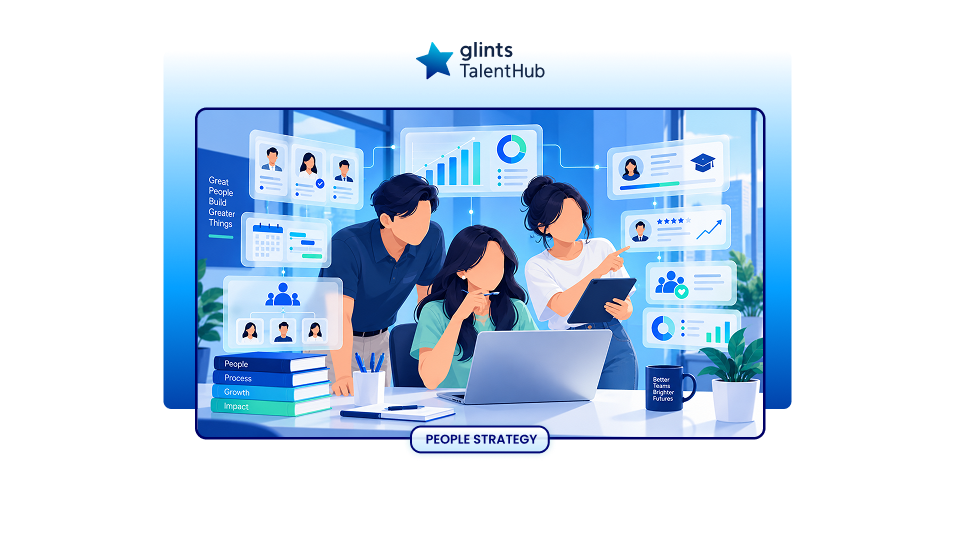
A people strategy provides a clear plan for attracting, developing, supporting and retaining the talent a company needs. It connects hiring, leadership, performance, employee experience and workforce planning with the organisation’s wider business objectives.
In this guide, you will learn what a people strategy is, why it matters and how to create one that supports both business growth and employee success.
What is a People Strategy?
A people strategy is a long term plan for attracting, developing, engaging and retaining the people a company needs to achieve its business goals. It connects decisions about talent, culture, skills, leadership, performance and rewards with the direction of the business.
In simple terms, a business strategy explains where the company wants to go. A people strategy explains how the workforce will help it get there.
For example, a company planning to expand into three new markets may need leaders with regional experience, employees with local knowledge, new hiring channels and compliant employment arrangements. A company introducing artificial intelligence into its operations may need to redesign roles, train current employees and recruit people with new technical skills.
Why is a People Strategy Important?
People decisions affect almost every business outcome. The right strategy helps a company build the capacity it needs while creating an environment where employees can perform and grow.
1. It Connects Talent Decisions with Business Priorities
Every workforce investment should support a clear business need. A people strategy helps leaders decide which roles are most important, which skills need to be developed and where hiring resources should be focused.
2. It Prepares The Company for Future Skills Needs
The skills a company needs today may not be the skills it needs in two years. Strategic workforce planning helps the company identify potential gaps early and decide whether to hire, develop, redeploy or engage external talent.
3. It Improves The Employee Experience
Employees are more likely to perform well when expectations are clear, managers are capable, development opportunities are accessible and rewards are fair. A people strategy turns these elements into a consistent employee experience.
4. It Supports Sustainable Growth
Rapid growth can expose weaknesses in recruitment, onboarding, payroll, management and compliance. A people strategy helps a company build repeatable systems before those weaknesses become expensive problems.
5. It Creates Accountability
When people priorities have defined owners, timelines and measures, leaders can see whether the strategy is producing results. This makes HR decisions easier to evaluate and improve.
People Strategy Versus HR Strategy
People strategy and HR strategy are closely related, but they are not always identical.
A people strategy describes how the organisation will build and support the workforce required to achieve its goals. It is a company wide responsibility shared by executives, managers, HR and employees.
An HR strategy focuses more specifically on the systems, policies, processes and capabilities the HR function will use to support that plan.
For example, the people strategy may identify stronger leadership as a priority. The HR strategy may then define the leadership programme, succession process, assessment method and learning platform required to support it.
The strongest organisations treat people strategy as part of business strategy, not as an isolated HR project.
The Core Pillars of a People Strategy
The exact structure will vary by company, but an effective people strategy usually covers the following areas.
1. Workforce Planning
Workforce planning determines what roles, skills, locations and employment models the company will need. It compares the current workforce with future business requirements and identifies the gaps.
2. Talent Attraction and Hiring
The hiring strategy should define how the company will reach suitable candidates, assess them fairly and move them through the process efficiently.
This includes employer positioning, sourcing channels, selection criteria, interview design, candidate communication and offer management. It should also consider how the company will hire in locations where it does not have a local entity.
Effective hiring is not only about speed. It is about finding people who can succeed in the role and contribute to the future direction of the business.
3. Onboarding and Integration
Onboarding gives new employees the context, tools, relationships and confidence they need to contribute. A consistent process should cover administration, role expectations, company culture, team connections and early development.
For distributed teams, onboarding must also address equipment, system access, time zones, communication habits and local employment requirements.
4. Learning and Capability Development
A people strategy should explain how employees will gain the skills required for current and future roles. This may include formal training, coaching, mentoring, project assignments, peer learning and internal mobility.
Development should be linked to real capability gaps. Offering a large training catalogue is less valuable than helping employees build the specific skills the business needs.
5. Performance and Productivity
Performance management should help employees understand what success looks like, receive useful feedback and improve their contribution.
This requires clear goals, regular conversations, fair evaluation and manager accountability. The process should support both business outcomes and employee development instead of becoming a yearly administrative exercise.
6. Leadership and Management
Managers shape the daily employee experience. They influence priorities, communication, workload, recognition, development and trust.
A strong people strategy defines what good management looks like and gives managers the skills and support to deliver it. Leadership development should reflect the company’s current stage, culture and future challenges.
7. Rewards and Recognition
Compensation, benefits and recognition should be competitive, fair and aligned with the behaviours the company values.
For companies with employees in several countries, this becomes more complex. Salary expectations, statutory benefits, taxes and market practices vary by location. The company needs a consistent philosophy with enough local flexibility to remain compliant and relevant.
8. Employee Experience and Engagement
Employee experience covers how people experience work from recruitment through departure. It includes communication, inclusion, wellbeing, career opportunities, workplace tools and trust in leadership.
Engagement surveys can help identify concerns, but listening alone is not enough. Employees need to see that feedback leads to clear decisions and visible action.
9. Retention and Succession
Not every departure can or should be prevented. The goal is to understand which skills and roles are most critical, why valuable employees leave and what conditions encourage them to stay.
Succession planning reduces dependence on a small number of individuals. It also gives employees a clearer view of possible career paths within the company.
10. People Operations and Compliance
Reliable people’s operations create the foundation for every other pillar. Employment contracts, payroll, benefits, leave, data protection and termination processes need to be accurate and compliant.
This is especially important when a company employs people across several countries. Local requirements can differ significantly, and an approach that works in one market may create risk in another.
If the company does not have a legal entity in a target country, an Employer of Record can provide the local structure needed to employ, onboard and pay team members compliantly.
How to Create a People Strategy
Step 1: Start With the Business Strategy
Review the company’s growth plans, customer priorities, operating model, financial targets and major risks. Identify the outcomes the workforce must enable.
Instead of beginning with a list of HR initiatives, begin with questions such as:
- Where will the business grow?
- What new capabilities will be required?
- What must the company do better than competitors?
- What workforce constraints could slow progress?
Step 2: Assess the Current Workforce
Build a clear picture of the workforce today. Review headcount, roles, skills, performance, turnover, leadership strength, engagement, compensation and location.
Combine quantitative data with feedback from employees and managers. Numbers may reveal where a problem exists, while conversations often explain why it exists.
Step 3: Identify the Most Important Gaps
Compare current workforce capabilities with future business needs. A gap may involve skills, capacity, leadership, location, culture, technology or operating processes.
Prioritise gaps according to business impact and urgency. Trying to address every people issue at once usually spreads resources too thinly.
Step 4: Define Clear People Priorities
Choose a small number of priorities that directly support the business plan. Each priority should describe the outcome, not only the activity.
For example, “launch a manager training programme” is an activity. “Improve manager capability so teams receive clearer goals and more useful feedback” is an outcome.
Step 5: Design the Initiatives
Decide what must change to achieve each priority. This may include new hiring plans, role design, manager training, salary reviews, onboarding improvements, workforce technology or employment support in new markets.
Consider how the initiatives work together. A company should not increase hiring significantly without also preparing onboarding, management capacity, payroll and employee support.
Step 6: Assign Ownership and Resources
Every initiative needs an owner, budget, timeline and decision process. Leaders and managers should understand their responsibilities, since HR cannot deliver a people strategy alone.
Step 7: Choose Meaningful Measures
Select measures that show both progress and impact. Useful metrics may include:
- Time to productivity for new hires
- Quality of hire
- Voluntary turnover in critical roles
- Internal promotion rate
- Skill gap closure
- Manager effectiveness
- Employee engagement
- Payroll accuracy
- Workforce cost
- Representation across levels
Avoid relying on a single metric. For example, a lower time to hire is not necessarily positive if early turnover or poor performance increases.
Step 8: Communicate the Strategy
Employees need to understand what is changing, why it matters and how it affects them. Managers should receive enough context to answer questions consistently.
Communication should continue throughout implementation. Regular updates build trust and make it easier to address concerns early.
Step 9: Review and Adapt
A people strategy should not remain fixed while business conditions change. Review progress regularly and adjust priorities when the company enters a new market, adopts new technology, changes its operating model or faces an unexpected talent constraint.
A Simple People Strategy Example
Imagine a technology company planning to expand from one market into four countries over the next two years.
Its business goal is to grow regional revenue while maintaining service quality. Its workforce assessment finds three major gaps: limited local market knowledge, inconsistent manager capability and no established process for employing people in the target countries.
The company sets four people priorities:
- Hire local commercial and customer support talent in each target market.
- Prepare current managers to lead distributed teams.
- Create a consistent regional onboarding experience.
- Establish compliant contracts, payroll, benefits and employee support in every hiring location.
It then measures hiring progress, time to productivity, manager effectiveness, employee engagement, payroll accuracy and retention in critical roles.
This is a people strategy because every priority is connected to the expansion plan. The company is not simply introducing separate HR programmes. It is building the workforce and operating systems required for growth.
Common People Strategy Mistakes
1. Treating It as an HR Document
A people strategy will struggle if business leaders do not own the outcomes. HR can guide the process, but executives and managers must make the strategy part of business planning and daily decision making.
2. Copying Another Company’s Priorities
Popular workplace practices are not automatically right for every organisation. The strategy should reflect the company’s goals, workforce, culture, resources and markets.
3. Creating Too Many Priorities
A long list can create the appearance of ambition while making execution difficult. Focus on the few workforce outcomes that will have the greatest effect on the business.
4. Focusing on Programmes Instead of Outcomes
Training sessions, surveys and new tools are activities. The strategy should make clear what improvement those activities are expected to produce.
5. Ignoring Local Differences
A global policy may need local adaptation. Employment laws, salary expectations, benefits and workplace practices differ across countries. Consistency should not come at the expense of compliance or employee relevance.
How Often Should a People Strategy Be Reviewed?
Most companies should conduct a formal review at least once a year and monitor progress more frequently, such as every quarter.
The strategy may need an earlier review when the company experiences major change, including expansion into a new country, restructuring, rapid hiring, leadership changes, an acquisition or the introduction of significant new technology.
The objective is not to rewrite the entire plan whenever conditions change. It is to confirm that the priorities, assumptions and investments still support the business.
Build a People Strategy That Can Scale
A strong people strategy turns workforce decisions into a coordinated plan for business growth. It clarifies the talent and skills the company needs, the experience it wants to create and the systems required to support employees consistently.
As a company expands across borders, execution becomes more complex. Recruitment, employment contracts, onboarding, payroll, benefits and local compliance all need to work together.
Glints TalentHub helps companies source, hire, onboard, pay and manage professionals across Southeast Asia through one integrated talent solution. Whether you need recruitment support, an Employer of Record, payroll services or ongoing people operations, you can build your regional team with stronger local insight and fewer operational gaps.
Ready to turn your workforce plan into action? Explore Glints TalentHub to build and manage your team across Southeast Asia.