


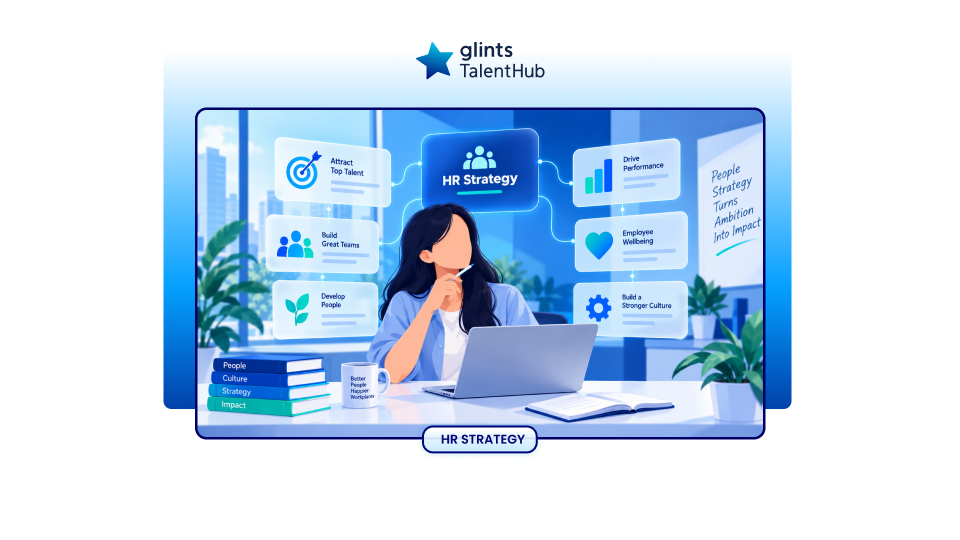
An effective HR strategy turns business priorities into clear decisions about people. It helps an organization determine which roles it needs, how to attract the right talent, what employees need to perform well, and how workforce costs should be managed.
Without a clear strategy, HR teams often spend most of their time responding to immediate requests. Recruitment begins only after a vacancy appears. Training is introduced after performance problems emerge. Retention becomes a priority only when valuable employees start leaving.
A strong HR strategy creates a more deliberate approach. It connects hiring, development, performance, compensation, compliance, and employee experience to the direction of the business.
What is an HR Strategy?
An HR strategy is a long term plan for managing an organization’s workforce in support of its business goals.
It identifies the people, skills, systems, and workplace practices the organization needs to succeed. It also establishes priorities for attracting, developing, rewarding, and retaining employees.
The exact priorities will depend on the organization’s size, industry, growth stage, and business model.
Why is HR Strategy Important?
People decisions affect nearly every part of business performance. A company may have a strong product and a promising market, but growth becomes difficult if it cannot find the right employees, retain critical skills, or build effective managers.
A clear HR strategy helps organizations make these decisions consistently.
1. It Connects People Priorities to Business Goals
An HR strategy ensures that recruitment, development, and workforce investments support what the business is trying to achieve.
For example, if a company plans to enter three new markets, its HR priorities may include international workforce planning, local talent acquisition, employment compliance, and leadership capability across different locations.
2. It Improves Workforce Planning
HR teams can anticipate future talent requirements instead of responding to vacancies individually. This gives the organization more time to decide whether it should hire, develop, relocate, or contract the capabilities it needs.
3. It Creates a Consistent Employee Experience
Clear HR principles help improving employees experience by providing consistent support throughout their journey, from recruitment and onboarding to development and offboarding.
Consistency can improve trust because employees understand how decisions about performance, promotion, compensation, and development are made.
4. It Supports Better Resource Allocation
Not every HR initiative deserves the same level of investment. A strategy helps leaders direct time and budget toward the workforce issues with the greatest business impact.
5. It Reduces Workforce and Compliance Risks
A structured approach to employment contracts, payroll, benefits, data protection, and workplace policies can reduce costly mistakes. This becomes especially important when an organization employs people across multiple countries.
HR Strategy vs People Strategy
HR strategy and people strategy are closely connected, but they are not always identical.
HR strategy usually focuses on the systems and practices used to manage the workforce. These include recruitment methods, performance management, compensation, compliance, and workforce planning.
People strategy takes a broader view of how people contribute to the organization’s success. It may include culture, leadership, organizational design, employee experience, and how work gets done.
In practice, the two should support each other. The terminology matters less than whether the organization has a clear and coordinated plan for its people.
The Main Components of an Effective HR Strategy
A comprehensive HR strategy usually covers several connected areas.
1. Workforce Planning
Workforce planning identifies the people and capabilities the organization will need in the future.
It considers questions such as:
- Which business areas are expected to grow?
- Which roles will become more important?
- What skills are currently missing?
- Which positions are difficult to recruit?
- Where should employees be located?
- Which roles can be filled through permanent hiring, internal development, or contract arrangements?
- How will automation affect existing roles?
Good workforce planning considers both headcount and capability. Hiring more employees will not solve a skills gap if the organization recruits for the wrong expertise.
2. Talent Acquisition
The recruitment strategy should define how the organization will attract and select the talent it needs.
This may include employer branding, recruitment channels, candidate assessment, interview processes, hiring timelines, cost per hire, and candidate experience.
For organizations hiring internationally, the strategy should also consider local salary expectations, talent availability, employment regulations, and the most appropriate hiring model.
3. Learning and Development
A learning strategy prepares employees for current responsibilities and future business needs.
Development priorities should be based on genuine capability gaps. These may include technical skills, management capability, communication, digital literacy, or knowledge of new markets.
Organizations can support development through formal courses, coaching, mentoring, project assignments, peer learning, and internal mobility.
4. Performance Management
Performance management should help employees understand what is expected and how their work contributes to company goals. A continuous performance management approach gives employees more regular feedback and helps managers address performance concerns earlier.
Annual reviews alone are rarely enough. Employees and managers need regular opportunities to discuss progress, barriers, priorities, and support.
5. Compensation and Benefits
Compensation should remain competitive, financially sustainable, and appropriate for the markets where employees work.
The strategy may cover salary structures, bonuses, benefits, allowances, pay reviews, and recognition programs.
Organizations with international teams also need to decide how they will balance internal fairness with different local market conditions and statutory requirements.
6. Employee Engagement and Retention
Retention is influenced by more than salary. Employees also consider management quality, career growth, workload, recognition, flexibility, trust, and whether their work feels meaningful.
An HR strategy should identify the experiences that matter most to critical employee groups. Engagement surveys, exit interviews, retention interviews, and workforce data can reveal where improvements are needed.
7. Leadership and Succession
Managers have a direct influence on performance, engagement, and retention. Developing capable managers should therefore be a central part of the HR strategy.
Succession planning is equally important. It identifies roles that would be difficult to replace and prepares potential successors before a vacancy occurs.
8. Compliance and Workforce Operations
Reliable HR operations provide the foundation for every other people initiative.
This includes contracts, payroll, statutory contributions, leave administration, employee records, workplace policies, and data protection.
The complexity increases when employees are based in different countries. Each market may have distinct rules governing employment, termination, benefits, tax, and payroll.
Common HR Strategy Mistakes
1. Creating HR Initiatives Without a Business Connection
A new HR program may sound valuable, but it should solve a clearly defined workforce or business problem.
2. Setting Too Many Priorities
A long list of priorities often leads to limited progress. Focus first on the areas with the strongest influence on growth, productivity, risk, or retention.
3. Relying Only on HR Data
Workforce metrics are important, but they need context. Conversations with employees, managers, candidates, and business leaders can explain what the numbers do not show.
4. Overlooking Managers
Even a well designed HR program can fail if managers do not understand it or lack the skills to apply it consistently.
5. Treating Strategy as a One Time Project
Business conditions, employee expectations, and talent markets change. The HR strategy should be reviewed and refined as new information becomes available.
6. Ignoring Local Employment Requirements
A policy that works in one country may not comply with the rules of another. International expansion requires local knowledge of contracts, payroll, benefits, leave, termination, and employee data.
How HR Strategy Supports International Growth
International hiring gives organizations access to larger talent pools, new capabilities, and local market knowledge. It also introduces additional operational and compliance responsibilities.
An Employer of Record can support companies that want to employ talent in a country where they do not have their own entity. The provider becomes the legal employer and manages areas such as compliant contracts, payroll, benefits, statutory contributions, and local employment administration.
This allows the company to focus on selecting, managing, and developing its talent while reducing the administrative burden of international employment.
Final Thoughts
HR strategy gives an organization a clear plan for building the workforce it needs. It connects business goals with decisions about hiring, development, performance, compensation, retention, and compliance.
The most effective strategies are focused, measurable, and practical. They begin with the direction of the business, assess the current workforce honestly, and concentrate resources on the most important capability gaps.
As an organization grows across markets, the strategy must also account for local talent conditions and employment requirements. With the right people plan and operational support, HR can move beyond responding to immediate needs and become a direct contributor to sustainable business growth.