


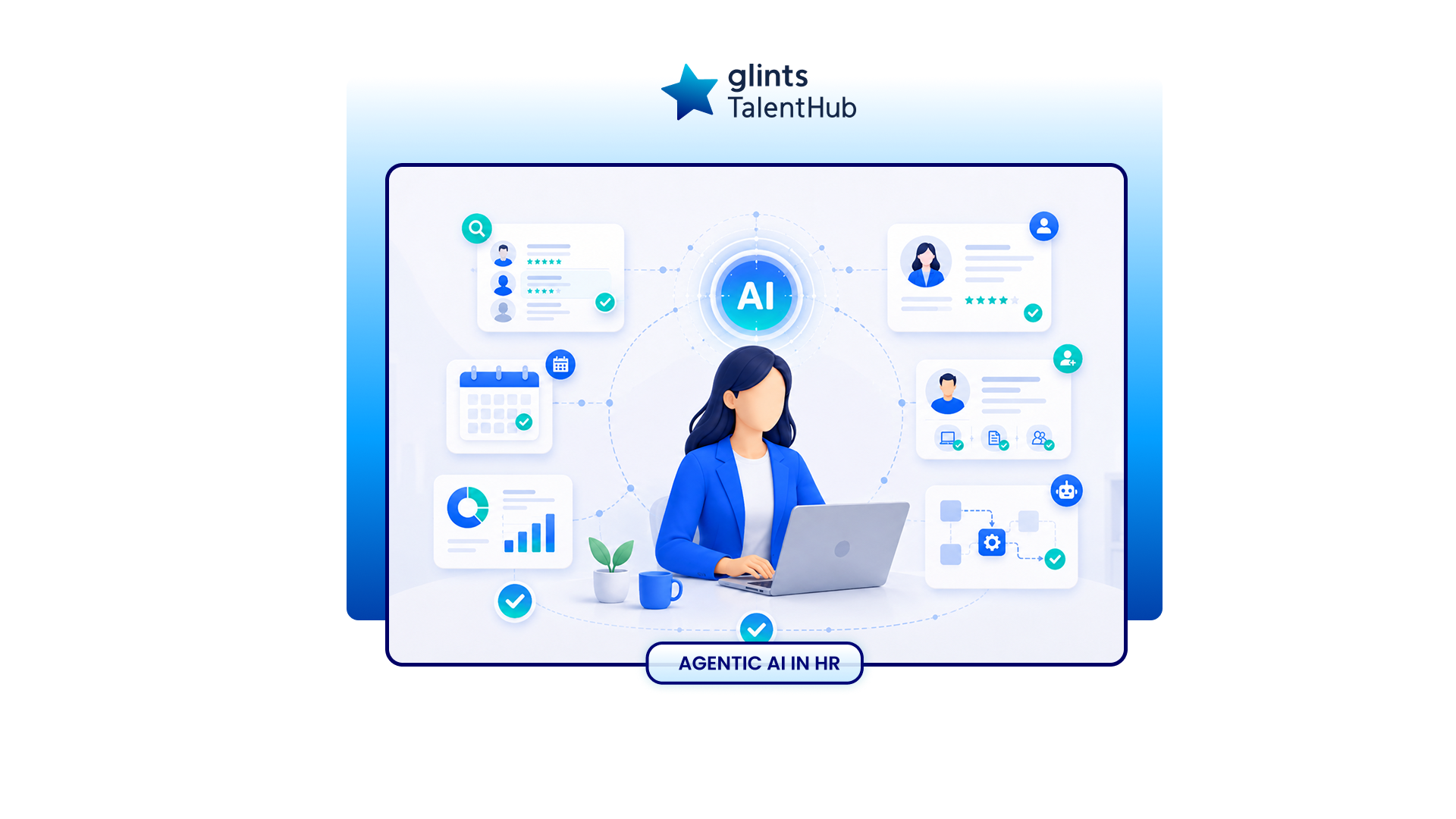
Artificial intelligence is already helping HR teams write job descriptions, summarize employee feedback and answer policy questions. Agentic AI takes this capability further.
Instead of waiting for an individual prompt, an AI agent can understand a goal, plan the necessary steps, access approved systems and complete parts of a workflow. It might screen incoming applications, coordinate interview schedules, prepare onboarding documents and notify the right people when action is required.
This creates an opportunity for HR teams to reduce administrative work and deliver faster employee support. However, giving AI permission to act also creates greater responsibility. Organizations need clear limits, strong data protection and meaningful human oversight.
What Is Agentic AI in HR?
Agentic AI refers to artificial intelligence systems that can plan, make decisions and take actions across multiple steps to achieve a defined goal.
A traditional AI tool usually completes one task at a time. For example, it might generate a job description after receiving a prompt.
An AI agent can manage a broader objective. If asked to begin hiring for a new role, it could:
- Review the approved role requirements
- Draft the job description
- Publish the vacancy through connected platforms
- identify potentially suitable candidates
- Coordinate interview availability
- Send reminders to interviewers
- Update the applicant tracking system
- Escalate exceptions to the recruiter
The agent does not necessarily have complete autonomy. Its permissions should depend on the sensitivity and consequences of each action.
Singapore’s Model AI Governance Framework for Agentic AI describes agents as systems with some ability to plan, decide and act independently across multiple steps. It also emphasizes that organizations and the people overseeing agents remain accountable for their actions.
How Does Agentic AI Work in HR?
An HR AI agent normally combines several components.
1. Defined Goal
The agent needs a clear objective, such as completing onboarding before an employee’s start date.
2. Instructions and Boundaries
Rules determine what the agent may do, what information it may access and when it must request human approval.
3. Access to Approved Tools
The agent may connect with an applicant tracking system, human resources information system, payroll platform, calendar, email or learning platform.
4. Memory and Context
The system may retain relevant context about previous actions, employee preferences or workflow status, subject to privacy and retention requirements.
5. Planning and Reasoning
The agent determines the sequence of tasks required to reach the goal.
6. Action and Monitoring
It performs approved actions, records what happened and escalates unusual or sensitive situations to a person.
This combination allows agentic AI to work across a process instead of completing only one isolated task.
Agentic AI Use Cases in HR
1. Candidate Sourcing
An AI agent can search approved talent sources, compare profiles with role requirements and create an initial list for recruiter review.
The system can also monitor the talent pipeline and recommend additional sourcing activity when candidate volume or quality falls below an agreed threshold.
Human review remains important. Historical recruitment data can contain patterns that disadvantage certain groups, while job requirements may not reflect the qualities that actually predict success.
2. Application Screening
Agentic AI can organize applications, identify required qualifications and highlight missing information.
It should support recruiter judgment rather than automatically reject candidates without appropriate review. Employment decisions can significantly affect people, so employers need to understand which information influenced the recommendation.
3. Interview Coordination
Interview scheduling is a suitable starting point because it is repetitive, measurable and relatively easy to supervise.
This reduces coordination work while allowing recruiters to spend more time engaging with candidates.
4. Employee Onboarding
Onboarding often involves HR, IT, payroll, finance and the hiring manager. An AI agent can coordinate tasks across these functions.
The agent should not receive broader system permissions than necessary. Access should be limited according to its task and removed when no longer required.
5. Employee Support
An AI agent can respond to common questions about leave, benefits, workplace policies and internal procedures.
Unlike a basic chatbot, it may also complete an approved action. For example, it could check an employee’s leave balance, explain the relevant policy and prepare a request for confirmation.
Complex or sensitive questions involving grievances, health information, disciplinary matters or individual legal rights should be transferred to a qualified person.
6. Payroll and Benefits Administration
Agentic AI can monitor payroll inputs, identify missing data and send reminders before the payroll cut off.
It may also help employees understand benefits, prepare enrollment requests and route exceptions to the appropriate team.
However, payroll rules differ by country and can change. The agent should rely on verified local information, maintain a clear activity record and require approval for material changes to pay.
7. Learning and Development
An AI agent can compare an employee’s current skills with role requirements and recommend relevant learning resources.
Recommendations should support employee growth without restricting opportunities based on incomplete performance or behavioral data.
8. Workforce Planning
Agentic AI can consolidate hiring demand, workforce capacity, turnover patterns and skills data to help HR leaders identify future gaps.
It can model different scenarios, such as whether to recruit locally, hire remotely, use contractors or build an international team.
These outputs should inform planning. They should not be treated as certain predictions about individual employees.
9. Performance Management
An AI agent can collect agreed performance information, remind managers about reviews and summarize feedback from approved sources.
It should not independently decide ratings, promotions, compensation or disciplinary action. Performance information can be incomplete and highly dependent on context that an automated system may not understand.
10. Offboarding
During offboarding, an agent can coordinate document preparation, equipment return, access removal and final payroll inputs.
This can reduce security and compliance risks caused by incomplete tasks. Sensitive decisions about termination, severance or employee disputes must remain under qualified human control.
Benefits of Agentic AI in HR
1. Reduced Administrative Work
Agents can manage repetitive coordination, reminders and data movement across systems. This gives HR teams more time for candidate engagement, employee support and workforce strategy.
2. Faster Employee Service
Employees can receive answers and complete routine requests without waiting for HR to manually move information between systems.
3. More Consistent Processes
An agent can follow the same approved workflow each time, helping reduce missed steps and inconsistent documentation.
4. Better Coordination Across Systems
HR processes often involve several platforms and departments. Agentic AI can help connect those steps and maintain visibility over the complete workflow.
5. Greater Operational Scale
As an organization grows across countries, HR teams need to manage more employees, regulations and service requests. Carefully governed agents can help teams handle higher volumes without allowing quality to decline.
Interest in human and agent collaboration is already affecting workforce planning. Microsoft’s 2025 Work Trend Index found that 28 percent of surveyed managers were considering hiring people to manage AI workforces, while 32 percent were considering AI agent specialists.
Risks of Agentic AI in HR
1. Biased or Unfair Outcomes
An AI system may reproduce bias from historical data, screening criteria or previous employment decisions.
The International Labour Organization warns that HR AI systems can use poorly aligned objectives, biased data and opaque programming, creating legal, ethical and practical risks.
Organizations should test results across relevant groups and investigate unexpected differences.
2. Incorrect Actions
An agent may misunderstand a policy, use outdated information or complete the wrong action. Because agentic AI can act across systems, an error can affect several stages of an HR process.
High impact actions should therefore require human approval.
3. Employee Privacy Concerns
HR systems contain personal, financial, employment and sometimes health information. An agent should only access the minimum data required for its purpose.
Organizations should define how information is collected, processed, stored and deleted before connecting an agent to employee data.
4. Lack of Transparency
Candidates and employees may not know that AI influenced a process or may not understand how to challenge an outcome.
HR teams should explain where AI is used, what role it plays and how a person can request review.
5. Excessive Automation
A process can become faster while delivering a worse employee experience. People may feel ignored if important workplace matters are handled entirely through automated interactions.
AI should create more capacity for meaningful human support, not remove it from moments where empathy and judgment matter.
6. Security and Unauthorized Access
An agent connected to several systems can create significant risk if its identity or permissions are compromised.
Access should be limited, recorded and regularly reviewed. Sensitive actions should use additional verification and approval.
7. Legal and Regulatory Exposure
Rules governing automated employment decisions vary by jurisdiction. Organizations operating internationally may face requirements covering data protection, discrimination, transparency and AI governance.
For example, certain AI applications used for recruitment and employment decisions may be classified as high risk under the European Union AI Act. Employers should assess local obligations before deployment and seek professional advice where necessary.
How to Implement Agentic AI in HR Responsibly
1. Begin with a Specific Problem
Choose a workflow with a clear objective, measurable volume and identifiable pain point.
Interview scheduling, document collection and routine HR requests are usually easier starting points than hiring decisions or performance evaluation.
2. Map the Complete Workflow
Document every step, system, decision and person involved. Identify where errors could affect candidates, employees or the organization.
3. Classify The Level of Risk
Consider the sensitivity of the data, the impact of an incorrect action and how easily the action can be reversed.
Higher risk tasks require tighter permissions and more human oversight.
4. Define What The Agent Can Access
Use the minimum level of access required. An onboarding agent, for example, should not automatically have access to complete employee records or the ability to change payroll.
5. Test Realistic Scenarios
Test normal cases as well as missing information, contradictory instructions, unusual employee requests and system failures.
Evaluate accuracy, fairness, privacy, security and the agent’s ability to escalate appropriately.
6. Keep Complete Activity Records
Record the information the agent accessed, the actions it performed, the approvals it received and any errors that occurred.
These records support audits, investigations and continuous improvement.
The Role of HR in an Agentic AI Workplace
Agentic AI does not reduce the importance of HR. It changes where HR expertise creates the most value.
HR leaders will increasingly need to:
- Decide which processes should be automated
- Define where human judgment is essential
- Protect candidate and employee interests
- Establish accountability for AI actions
- Train employees to work effectively with agents
- Measure whether AI improves the employee experience
- Redesign roles as administrative work changes
This makes HR central to both AI governance and workforce transformation.
Build a More Scalable International HR Operation
Agentic AI can simplify workflows, but international hiring still requires local recruitment knowledge, compliant employment, payroll administration and ongoing employee support.
Glints TalentHub helps companies source, hire, onboard, pay and manage professionals across Southeast Asia through one unified talent operations solution. This gives you the local expertise and operational support needed to grow international teams compliantly and at scale.
Explore Glints TalentHub to build and manage your Southeast Asian team with greater confidence.
Conclusion
Agentic AI represents an important shift from AI that produces information to AI that can coordinate and complete work.
For HR teams, the greatest value may come from reducing repetitive administration, improving employee support and connecting fragmented workflows. The greatest risks arise when agents receive excessive access or influence decisions that affect people’s employment, pay and opportunities.
The right approach is controlled autonomy. Give the agent a specific objective, limited permissions and clear approval points. Monitor its actions and keep people accountable for the outcomes.
When implemented responsibly, agentic AI can help HR become more efficient without losing the human judgment, empathy and trust that effective people management requires.