


A client we work with described a worry that I see in many forms across remote teams.
Their business grew up with people physically on the ground. Now they were hiring for digital roles, and they had discovered how much wider the talent pool gets when people can work remotely. They loved that part. What worried them was everything around it. Some people were logging in late. They were not sure the clock in data was accurate. They wondered whether a few staff were doing other jobs on the side. They had questions about how sick leave and medical certificates were tracked.
Their ask was for more control over the team.
But when we asked what they actually wanted to see, the answer was not control. They wanted a monthly view of days worked, leave taken and what the team had delivered. That is a very different request. It was a request for visibility, and for a shared idea of what good looks like.
The Real Problem Is Measurement
I think most distrust in remote teams is a measurement problem wearing a trust costume.
Managers who used to see their team across the room now see a green dot. So they watch the green dot. They check login times, hours online and response speed. These are easy to see, so they become the measure. But they say very little about the work.
The side effects are predictable. People who are rewarded for looking busy learn to look busy. People who are honest feel watched. And the manager still does not know whether the work is good.
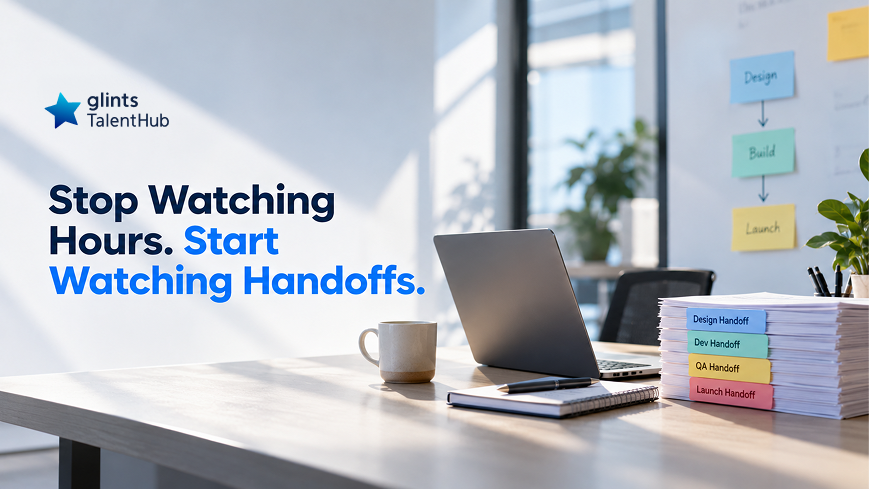
What matters is somewhere else. I call it the handoff. A handoff is the moment work passes from one person to another, to the manager, or to a customer. It has a date, it can be seen, and it matters. If handoffs land on time and at the right quality, hours online tell you little more about delivery. Working hours and coverage commitments still need to be met where they apply. If handoffs do not land, no amount of clock watching will fix it.
This is one of the practical challenges of managing remote employees: making progress visible when you no longer share the same room.
The Visibility Ladder
To make this practical, I use a simple ladder with four rungs. Each rung answers a different question about the person and the work.
- Presence. Are they there? This covers logins, clock ins and attendance.
- Rhythm. Do commitments land when promised? This covers updates, handoffs and response times.
- Output. What shipped? This covers drafts, tickets, reports and anything else you can point to.
- Outcome. Did it matter? This covers quality, rework and the result for the customer.
Most managers camp on the bottom rung. They do this because it is the only one the tools show for free, not because it is the best one. Moving up takes a decision, not a better tool.
Two rules help. First, pick the fewest signals you can for each rung, and rely more on the higher rungs. Second, treat the lower rungs as an early warning, not a verdict. A pattern of late logins is a reason for a conversation. It is not proof of anything.
The ladder also gives continuous performance management something concrete to work with. Regular conversations become easier when both people can point to the same commitments, handoffs and results.
Agree It in Week One
The ladder only works if the person on the receiving end knows about it. So I make it part of remote onboarding and agree it with each new team member in their first week, on one page, with five questions.
- What does good look like at the end of week one, month one and month three?
- Which signals will we look at, and why those?
- How often will we look at them together?
- What will trigger a conversation, and what will not?
- What will we never monitor?
The last question does the most work. Saying out loud what you will not watch is what makes the rest acceptable. It tells the person that this is about the work, not about them.
If I were sitting with the client above, I would start there. The monthly view of days worked and leave becomes the base layer. On top of it sits a short monthly note on what was delivered against what was agreed. A late login becomes a reason to talk only if it becomes a pattern or affects an agreed commitment. And the question about side jobs gets handled through the contract and a direct conversation, not through more monitoring.
Where This Breaks
None of this is perfect. A few honest limits.
- Some roles need presence. Coverage roles, such as live support or shift work, depend on someone being there at a set time. In those jobs, presence is part of the output. Say so, and explain why, instead of pretending otherwise.
- The data can be wrong. The client was right to question the accuracy of clock in data. Check that a signal is reliable before you act on it.
- Leave needs its own process. How leave and medical certificates are submitted, and who sees them, differs by market. Be clear about this at the start, and make sure managers know the local rules. A clear employee data collection process helps define what information is needed, where it is submitted and who can access it.
- Managers need help. Many managers have never led a remote team. A new rung is a new habit, and habits take coaching.
What to Try This Week
- Pick one role. Write down what it shipped last month and which handoffs it owns.
- Draft the five questions for that person. Share them, and ask what they would add.
- Choose one presence signal you track today. Ask what decision it helps you make. If there is none, and it is not needed for employment records or an agreed coverage requirement, stop watching it.
Why I Am Sharing This
Almost every manager I talk to about remote teams asks for the same thing sooner or later. They want to know how the team is doing, without feeling like they are spying on it. That is a fair thing to want. It just needs a better answer than a green dot.
This is part of why Glints TalentHub helps companies hire and employ teams across the region. Its Employer of Record service supports local employment contracts, payroll and HR administration, giving managers more room to focus on the work and the people doing it.
The tools matter. But the agreement between a manager and a person matters more, and it starts with deciding what you will look at and why.
If you lead a remote team, I would like to hear which rung you spend most of your time on.