

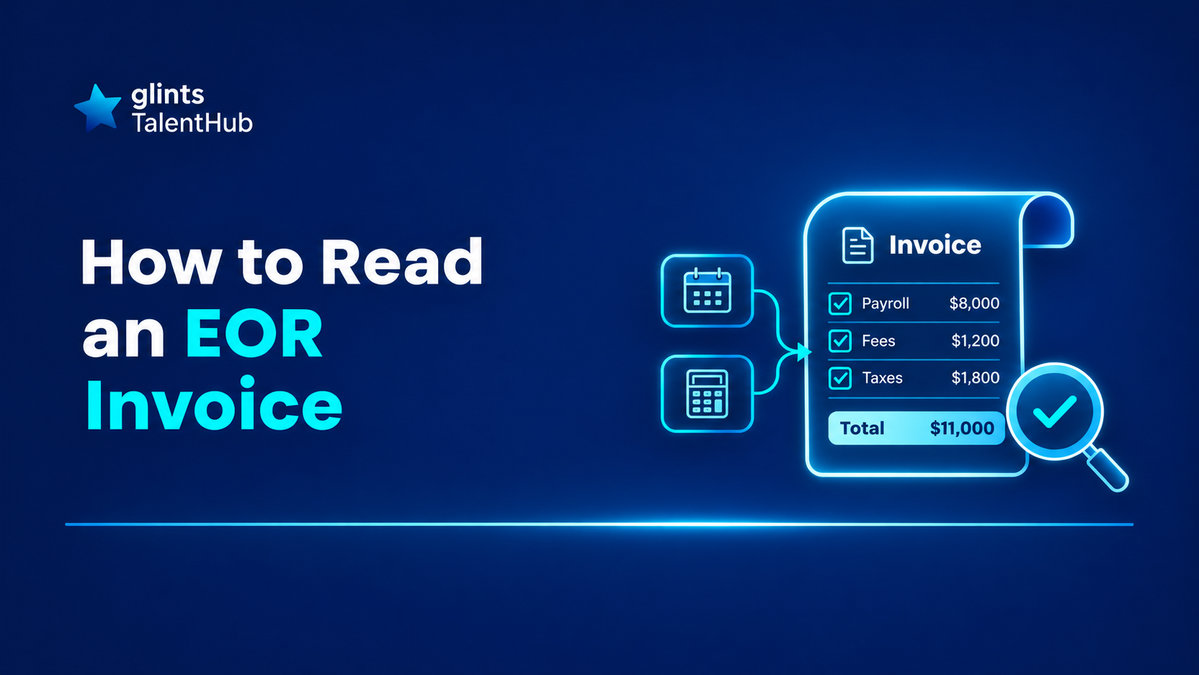
An EOR invoice should reconcile to the approved payroll, not merely look reasonable in total. Match gross salary, employee deductions, employer contributions, benefits and corrections first. Then separate the service fee and one-off charges from refundable deposits, payroll prefunding and credit balances. Finally, verify the applied foreign-exchange rate, funding deadline and cash actually due.
A SGD 10,000 Singapore salary shows why line-level review matters. For a qualifying citizen aged 55 or below, employer CPF is SGD 1,360, not SGD 1,700, because the 2026 Ordinary Wage ceiling is SGD 8,000. An invoice can therefore balance arithmetically while still using the wrong contribution base. This guide provides an invoice audit, cash-flow view and backwards funding calendar.
What Is an EOR Invoice?
An EOR invoice is a request to fund employment obligations and pay the provider’s agreed charges for a stated employee, country and payroll period.
It is different from a payroll register. The register explains how gross pay becomes net pay. The invoice explains how much the client must transfer, in which currency and by what date. Finance should connect both records using the employee ID, pay period and payroll-run reference.
If your team needs the broader model first, TalentHub’s Employer of Record guide explains how the legal-employer relationship works.
Ten Lines Explain Most EOR Invoices
Every invoice line should identify the employee, payroll period, local amount, billing amount and supporting record. A bundled “employment cost” line prevents finance from testing the payroll.
|
Invoice line |
What it represents |
Approval evidence |
|
Gross salary |
Contractual earnings before employee deductions |
Contract, salary-change approval and payroll register |
|
Employee deductions |
Amounts withheld from gross pay, such as employee contributions |
Employee-level payroll calculation |
|
Employer contributions |
Additional employer-funded statutory cost |
Current official rate, base, ceiling and payroll calculation |
|
Benefits |
Insurance or other employee benefits |
Enrolment record, provider invoice and agreed mark-up |
|
Service fee |
The EOR’s recurring charge |
Order form, fee schedule and active headcount |
|
Refundable deposit |
Security held under the service agreement |
Deposit formula, balance record and refund terms |
|
Payroll prefunding |
Cash supplied before salary and liabilities are paid |
Payroll period, funding reference and later reconciliation |
|
FX rate or spread |
Conversion between payroll and billing currencies |
Rate source, timestamp, direction and disclosed margin |
|
One-off charges |
Background checks, immigration or agreed special work |
Prior approval and third-party evidence |
|
Credits and corrections |
Unused funding, reversals or earlier payroll differences |
Original invoice reference and correction calculation |
TalentHub’s EOR cost guide covers budgeting and provider pricing. The control here starts after those commercial terms have been agreed.
Expense and Cash Flow Are Different Questions
Salary, employer contributions, benefits and the service fee normally describe the period’s employment or service activity. A refundable deposit is cash held under contractual conditions, while payroll prefunding supplies cash before the EOR disburses payroll.
That distinction matters because the amount transferred can exceed the current month’s operating cost. It does not mean the extra cash automatically becomes another month of salary expense.
Finance should map each line to its own accounting policy, contract and professional advice. This article does not provide accounting advice. The safe operational rule is to record deposits, prefunding and credit balances separately from current-period charges so that later invoices cannot bill previously funded amounts again.
A Sample EOR Invoice Audit
Assume one Singapore citizen aged 55 or below receives SGD 10,000 entirely as Ordinary Wages. There are no Additional Wages. The illustrative invoice also contains a SGD 200 benefit, SGD 500 service fee, SGD 150 off-cycle correction to a prior net transfer, SGD 120 approved one-off charge, SGD 300 credit and SGD 10,000 refundable deposit.
According to the CPF Board, as of November 2026 the applicable full rates are 17% employer and 20% employee, while the Ordinary Wage ceiling is SGD 8,000.
|
Audit step |
Calculation |
SGD |
|
CPF-assessable Ordinary Wages |
|
8,000 |
|
Employee CPF deduction |
|
1,600 |
|
Employer CPF |
|
1,360 |
|
Net salary |
|
8,400 |
|
CPF remittance |
|
2,960 |
|
Benefits, service fee, correction and one-off charge |
|
970 |
|
Current funding before credit |
|
12,330 |
|
Credit balance |
Prior funding returned to this run |
(300) |
|
Payroll prefunding due |
|
12,030 |
|
Refundable deposit |
Illustrative contractual amount |
10,000 |
|
Total cash requested |
|
22,030 |
The SGD 1,600 employee CPF deduction reduces net salary but does not reduce the client’s gross salary cost. The EOR uses that withheld amount, together with employer CPF, in the SGD 2,960 remittance. Adding gross salary and total CPF without removing the employee deduction would count SGD 1,600 twice.
If the invoice converts SGD 22,030 at SGD 1.35 per USD, the billed amount is USD 16,318.52. At a reference rate of SGD 1.36 per USD, it would be USD 16,198.53. The USD 119.99 difference is not proof of an improper spread, but it is a variance finance should explain using the agreed rate source, timestamp and fees.
For the wider month-end control after payment, use TalentHub’s payroll reconciliation checklist.
Build the Funding Calendar Backwards From Payday
The EOR’s internal cut-off does not replace the legal employer’s salary deadline. Finance should begin with the required or contractual payday, subtract bank-processing and funding time, then set invoice-review and payroll-approval dates.
|
Market |
Official salary-payment rule |
Funding implication |
|
Singapore |
Salary must generally be paid at least monthly and within seven days after the salary period, as of November 2026 |
Funds must clear before the chosen payday and no later than the applicable statutory limit |
|
Malaysia |
Section 19 requires wages to be paid no later than the seventh day after the wage period, based on the official text retrieved November 2026 |
The provider’s payment run and client funding deadline must sit before that seventh-day limit |
|
Philippines |
Wages must generally be paid at least every two weeks or twice monthly, at intervals no longer than 16 days, as of November 2026 |
A single month-end funding cycle may not fit the required pay frequency |
For a planned Friday payday, a practical backwards calendar might be:
- Friday, payday: Employees receive cleared funds.
- Thursday: EOR confirms the bank file and payment release.
- Wednesday: Client funds arrive in the required currency.
- Tuesday: Treasury releases payment after checking FX and beneficiary details.
- Monday: Finance approves the invoice against the final payroll register.
- Previous Friday: HR approves payroll changes and exceptions.
- Earlier cut-off: Employees and managers submit payroll inputs.
The actual lead time depends on currencies, banks, public holidays and the service agreement. TalentHub’s payroll cut-off guide explains the earlier input stage.
Review the Invoice in Seven Steps
- Confirm the employee, country, payroll period and invoice version.
- Match gross salary, benefits and changes to approved source records.
- Recalculate employee deductions and employer contributions using current official rules.
- Prove that net salary plus liabilities connects to the gross-pay calculation.
- Separate recurring charges, one-off charges, deposits and prefunding.
- Reperform the FX conversion and explain every credit or prior-period correction.
- Approve only the additional cash due, then retain the invoice, register, approvals and funding evidence together.
If you expect several hires in one country for the long term, compare the control effort and EOR fee with running payroll through your own entity. If you have a small regional team without local entities, an EOR can be practical, but your company should retain invoice approval and cash-release controls.
What Employers Get Wrong About EOR Invoices
Treating the deposit as another payroll month: A refundable deposit still consumes cash, but its contract and balance should remain distinct from current payroll.
Adding employee deductions to gross cost: Employee deductions are withheld from gross salary. They are not an extra employer charge.
Approving an FX total without the rate: Require the currency pair, direction, rate source, rate date and any separate spread or transfer fee.
Ignoring negative lines: A credit should identify the original employee, period and invoice. An unexplained group credit can conceal an unresolved overpayment.
Rolling corrections into “other”: Off-cycle adjustments should state whether they correct gross pay, net transfer, statutory liability, benefit or fee. Each treatment changes a different part of the control.
FAQ About EOR Invoices
Is Payroll Prefunding an Extra EOR Cost?
No. Payroll prefunding is normally cash supplied before the EOR pays employees and other payroll obligations. The later invoice or reconciliation should show how that funding was used. Any unused amount should become a traceable credit, carry-forward balance or refund under the agreement.
Is an EOR Deposit Refundable?
Only the contract can answer that. Check the deposit formula, permitted deductions, holding currency, return trigger and refund deadline. Finance should also confirm whether the deposit changes after a salary increase, new hire, termination or material change in the provider’s credit assessment.
How Should Finance Check an EOR Exchange Rate?
Record the currency pair, quote direction, source, timestamp and applied rate. Reperform the conversion and compare it with the agreed benchmark. Ask whether the spread, bank fee or intermediary charge is shown separately or incorporated into the rate.
What Happens When Payroll Changes After Funding?
The provider should issue a corrected invoice, debit note, credit note or reconciliation that references the original payroll period and funding amount. Do not approve a replacement total unless the document shows what was already paid and the additional cash now due.
Should an EOR Invoice Equal Net Payroll?
Not usually. Net payroll excludes employer contributions, benefits, service fees and other approved costs. The invoice may also include deposits or prefunding. Finance should build a bridge from gross pay to net pay and then from payroll obligations to the final cash request.
Get an EOR Funding Schedule Before the First Payroll
You can run these controls internally when you have an entity and local payroll capability. If you need to employ people in Southeast Asia without setting up local entities, talk to TalentHub about an EOR payroll and funding schedule for your countries, currencies and planned paydays.
Key Takeaway
Approve an EOR invoice only when each payroll line, funding balance and currency conversion has an owner and supporting record. The decisive number is not the invoice total: it is the additional cash due after approved payroll, previous funding, credits and refundable balances are connected.