



An owned-entity EOR employs the worker through a company in the provider’s corporate group. A partner-network EOR uses a separate local employer. Ownership can remove one organisational handoff, but it does not prove lawful operations or good service. A partner adds another relationship to manage, yet may provide established local coverage. The evidence for the actual country matters more than the label.
Routine onboarding can make both models look similar. The difference becomes clearer when payroll is wrong, an employee needs a local answer, data must be traced or the workforce has to move. Buyers should therefore follow the employment, money, data and escalation chains from beginning to end. This guide compares those chains and shows what to request before choosing either structure.
What Is an Owned-Entity or Partner-Network EOR?
An owned-entity EOR uses a local employing company within the provider’s corporate group. A partner-network EOR contracts with an independent local company that becomes the employee’s legal employer.
Both are delivery structures within the broader Employer of Record model. They are not separate types of worker relationship. Singapore’s Ministry of Manpower states that a worker employed by an EOR is an employee where a contract of service exists between the worker and the EOR, even when the worker performs work for the EOR’s client.
The relevant question is therefore not simply, “Do you own an entity?” It is, “Which entity employs this person, and how does every obligation reach that entity?”
The Operating Models Change Eight Practical Chains
|
Factor |
Owned-entity model |
Partner-network model |
|
Employing entity |
A local company in the provider’s group |
An independent local partner |
|
Contract chain |
Client to provider; group employer to employee |
Client to provider; provider to partner; partner to employee |
|
Payroll control |
Provider may control payroll directly or use another vendor |
Partner commonly runs or controls local payroll |
|
Employee data |
May move among client, platform, group employer and payroll vendors |
May also pass to the independent partner and its vendors |
|
Local representation |
Group employees or appointed local representatives |
Partner’s local team represents the employer |
|
Support escalation |
Usually handled within one corporate group |
Platform and partner must coordinate ownership and response |
|
Pricing |
Reflects the quoted service, employment costs and any outsourced components |
May include partner costs or margins, but can still be competitively priced |
|
Transition |
Group employer controls relevant records, subject to actual systems and local rules |
Platform may need partner cooperation for records and employment steps |
The table describes common structures, not guarantees. An owned entity can outsource payroll, benefits or support. A partner-based service can integrate systems and escalation well. Ask each provider to replace this generic map with the actual parties serving your target country.
The Employing Entity Determines the Local Relationship
The local employer signs the employment contract, appears on employment records and performs employer-side duties under applicable local rules. Corporate ownership changes who owns that employer; it does not remove the employer’s separate legal identity.
For Singapore employees, MOM’s November 2023 parliamentary answer gives a useful anchor: an EOR worker is considered an employee as long as the worker has a contract of service with the EOR. The worker receives Employment Act entitlements even though work is performed for the EOR’s client.
That rule does not prefer an owned entity or partner. It tells buyers to identify the exact employer named in the contract.
Payroll Control Depends on Authority, Not Branding
An owned model can shorten the route from the provider’s account team to its local employer. However, the group may still use separate payroll software, an external bureau or a local bank process. Ownership alone does not show who can approve an off-cycle payment or correct a filing.
A partner model normally adds a provider-to-partner handoff. That can slow a correction if the platform cannot instruct the local payroll team directly. It can also work well where the partner has experienced payroll staff and clear authority.
Ask both providers for the same demonstration: who receives approved inputs, who calculates payroll, who releases funds, who files locally and who can authorise a correction. Compare the complete cost through an EOR pricing breakdown, not an assumed ownership premium.
Employee Data Follows Processing Roles
Employee records may include names, addresses, salaries, bank details and tax information. The number of corporate logos involved does not reveal where those records are stored or processed.
Singapore PDPC guidelines, revised 29 April 2026, use payroll administration as an example of data-intermediary processing. They state that an organisation has the same PDPA obligations for personal data processed on its behalf as if it processed the data itself. The guidelines also recommend defining the intermediary’s scope and responsibilities in writing.
For an owned model, map the client, platform, local employer and any payroll vendor. For a partner model, add the local partner and its vendors. Request a data-flow diagram, processing purposes, storage and access locations, subprocessor list, incident route, retention periods and evidence whose scope covers the actual service.
Local Support and Escalation Need Named Owners
An owned entity can place the account team and employer within one corporate group, reducing the number of organisations involved. It does not guarantee that a local decision-maker answers employee questions or that support has authority over payroll.
A partner can provide established local representation in a market where the platform has limited depth. The trade-off is that the employee may contact the partner while the client contacts the platform. Someone must own communication across that gap.
Request the names or roles for routine employee support, urgent payroll incidents and employment decisions. Ask which team speaks to the employee, who can make a local decision, when the platform intervenes and what happens if the two organisations disagree.
A Missed Payment Exposes the Accountability Chain
Suppose your company approved payroll and transferred funds on time, but the employee has not been paid.
In an illustrative owned structure, the chain might be:
Client → provider account owner → group payroll owner → bank → employee
In a partner structure, it might be:
Client → platform support → partner manager → partner payroll owner → bank → employee
The extra partner step is visible, but chain length is only the starting point. A group payroll owner without authority may respond more slowly than a well-integrated partner. Test both providers by asking who confirms the failure, who can release payment, who updates the employee and what evidence closes the incident. Record the promised times rather than accepting “single point of contact” as the answer.
Request Evidence for the Structure You Are Buying
Use a one-page operating-model record for every country:
- Name the commercial supplier and local employing entity.
- State whether the employer is group-owned or independent, with supporting corporate evidence.
- Identify every contract connecting the client, provider, employer and employee.
- Name the payroll calculator, approver, funder and filing party.
- Draw the employee-data flow, including payroll vendors and support tools.
- Record local employee contacts and the urgent escalation owner.
- Compare itemised fees, funding requirements, foreign-exchange treatment and pass-through charges.
- Document who supplies records and performs employment steps during a transition.
This is not a substitute for wider provider due diligence. It is a focused way to make the operating structure visible.
What Employers Get Wrong About Entity Models
Treating ownership as a compliance certificate. Incorporation within a provider’s group does not establish that the entity has the required registrations, people, processes or authority for a proposed arrangement.
Treating partners as automatically inferior. A capable local partner may have deeper operational experience than a recently established subsidiary. The additional handoff still needs to be measured and governed.
Assuming one model applies globally. Providers can own entities in some countries and use partners elsewhere. Record the model by country and require notice before the employer changes.
Ignoring the exit chain. Changing provider may involve employment documents, final pay, benefits, records and employee communication. A partner-dependent transition can require another party’s cooperation, while an owned entity may still hold records across several systems. Use a documented plan when switching EOR providers.
Choose the Model by Country and Failure Path
Prefer an owned-entity proposal when shorter internal escalation, consistent group control and direct access to the local employer are important, provided the provider demonstrates those features in practice.
Accept a partner-network proposal when it supplies needed country coverage or stronger local capability, provided the partner is disclosed and the platform remains accountable for coordination.
The safest recommendation is conditional: choose the model that produces the clearest evidence for your country and performs better in a realistic failure test. Do not award the decision to either ownership label before tracing payroll, data, support and exit.
FAQ About Owned and Partner EOR Models
Is a Partner-Network EOR Legal?
A partner structure is not inherently unlawful. The proposed employment arrangement must fit the rules applying in the worker’s country, role and circumstances. In Singapore, MOM focuses on whether the worker has a contract of service with the EOR when describing employee status. Confirm the named employer and obtain country-specific advice before onboarding.
Does an Owned Entity Make an EOR More Compliant?
No. Ownership can reduce organisational handoffs, but it does not establish registrations, correct payroll, effective data controls or capable local staff. Review evidence for the actual employing entity and service. A partner model also requires evidence, with additional attention to the agreement and operating route between the platform and local employer.
Which EOR Model Costs Less?
Neither model is always cheaper. An owned provider funds entities and local operations, while a partner-based provider pays another company for local delivery. Either can price efficiently or add charges. Compare an itemised country quote covering the service fee, employment costs, benefits, deposits, foreign exchange, additional work and transition charges.
Can One Provider Use Both Models?
Yes. A provider may use owned entities in core markets and partners for wider coverage. Treat each country as a separate operating record. Ask for the proposed employer before signing and require advance notice if that entity or delivery model changes.
Compare the Structure Behind Your Southeast Asia Hire
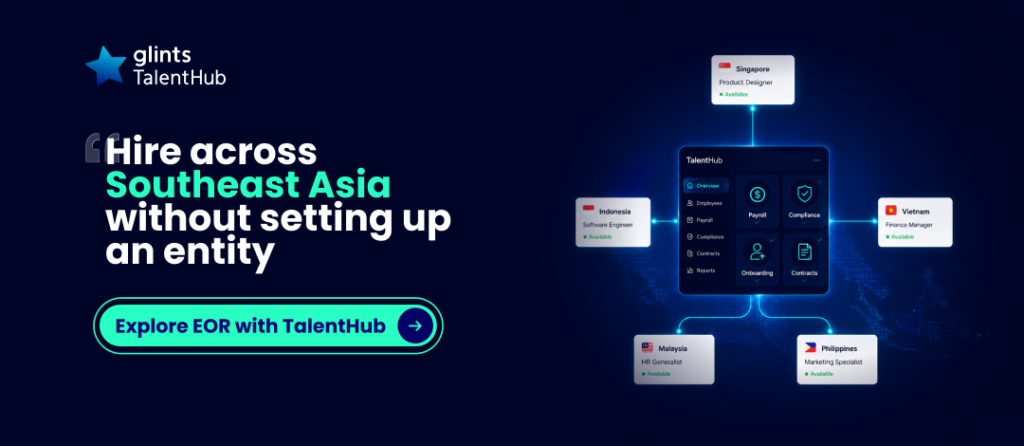
You can build your own local employment operation or use an EOR with an owned, partner or mixed structure. Glints TalentHub’s Employer of Record service can provide a country-specific employment and support model for comparison. Ask for the employing entity, payroll chain, data flow and escalation route before deciding.
Key Takeaway
Owned entities can shorten accountability chains; partner networks can extend coverage and add local capability. Neither structure proves the result. Choose by tracing the actual employer, contracts, payroll authority, data recipients, local support and transition path for each country.