


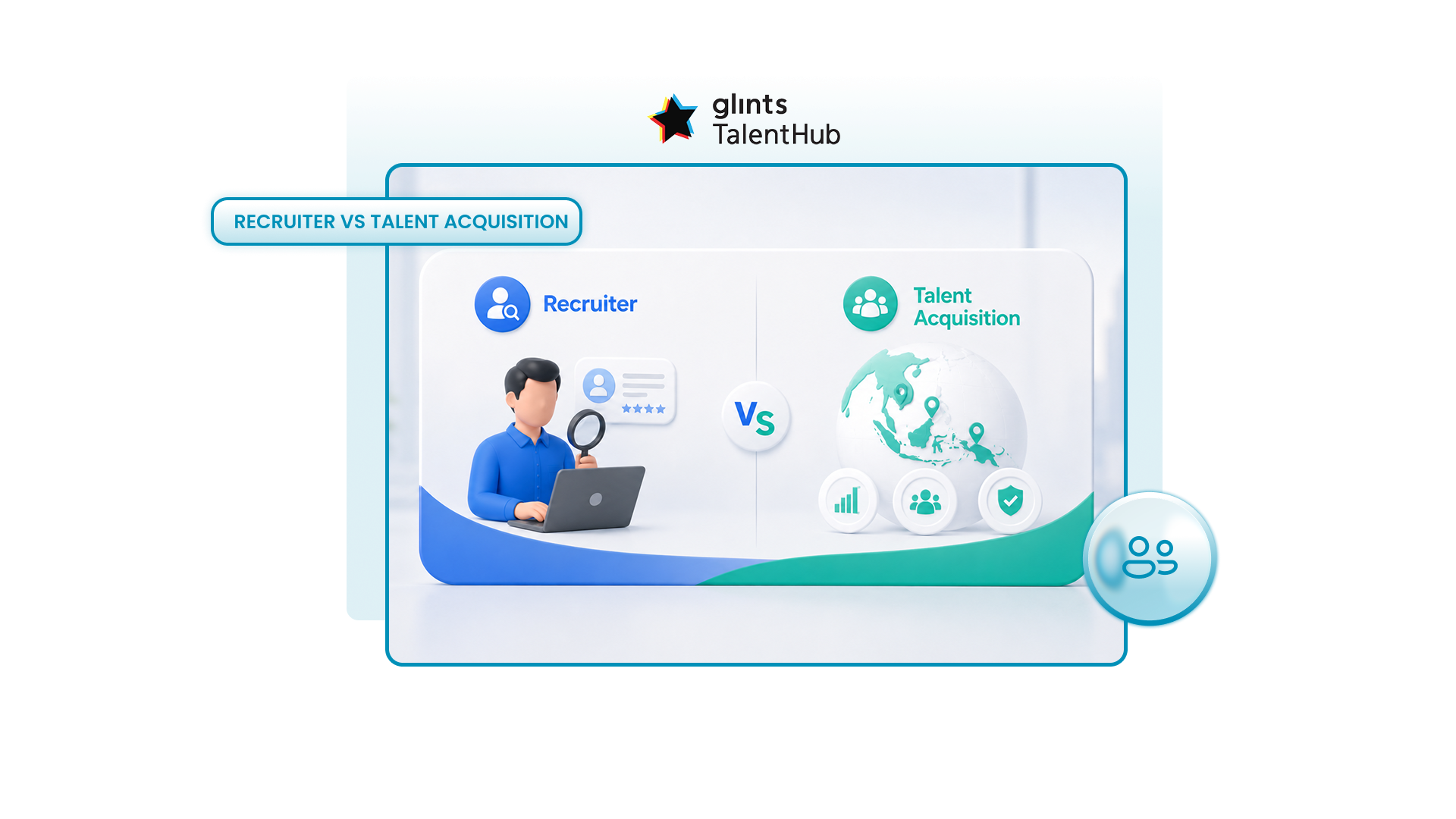
Recruiters and talent acquisition professionals share one important goal: helping a company bring in the right people. However, they often approach that goal from different angles.
A recruiter typically focuses on filling current vacancies efficiently. A talent acquisition professional looks beyond immediate openings and builds a longer term plan for attracting, engaging and retaining the talent a company will need as it grows.
The difference is not simply operational versus strategic. Both roles require planning, market knowledge and strong relationships with candidates and hiring managers. The main distinction lies in their scope, time horizon and level of involvement in workforce planning.
Understanding these differences can help you structure your hiring function, choose the right support and improve the experience for both candidates and hiring teams.
What is a Recruiter?
A recruiter is responsible for finding and guiding suitable candidates through the hiring process for open positions.
Recruiters usually work from a defined hiring requirement. This may include a job description, target experience, salary range, location and expected start date. They then identify potential candidates, assess their suitability and coordinate the selection process with the hiring manager.
A recruiter may work internally as part of a company, externally through a recruitment agency or independently as a consultant.
What is Talent Acquisition?
Talent acquisition is the ongoing process of identifying, attracting and engaging people who can support a company’s current and future workforce needs.
It includes recruitment, but its scope is broader. Talent acquisition may involve employer branding, workforce planning, talent market research, candidate relationship management, succession planning and hiring process improvement.
Talent acquisition is particularly valuable when a company expects sustained growth, needs scarce skills or plans to enter new markets.
Recruiter vs Talent Acquisition at a Glance
The main differences between recruitment and talent acquisition can be seen across several areas.
1. Primary Goal
A recruiter focuses on filling current vacancies.
Talent acquisition focuses on building the workforce needed for both current operations and future growth.
2. Time Horizon
Recruitment generally addresses immediate or short term hiring needs.
Talent acquisition works across a medium to long term horizon.
3. Starting Point
Recruitment usually begins with an approved vacancy and a defined job description.
Talent acquisition may begin with a business plan, expansion goal or anticipated capability gap.
4. Typical Activities
Recruitment includes sourcing, screening, interview coordination and offer support.
Talent acquisition includes workforce planning, employer branding, talent mapping, pipeline development and recruitment.
5. Candidate Engagement
Recruiters usually engage candidates when a suitable position is available.
Talent acquisition professionals may build relationships with candidates before a specific vacancy exists.
6. Success Measures
Recruitment success is often measured through time to fill, cost per hire, offer acceptance and completed placements.
Talent acquisition may also measure quality of hire, retention, pipeline health, workforce readiness and employer brand performance.
7 Key Differences Between Recruitment and Talent Acquisition
1. Immediate Vacancies Versus Future Workforce Needs
Recruitment often begins when a position becomes available. The company has an immediate need and the recruiter is asked to find suitable candidates.
Talent acquisition can begin months before a role is approved. A talent acquisition team may map potential candidates, study salary expectations and identify the strongest sourcing channels before hiring starts.
For example, a company planning to open a new sales hub may need ten employees within six months. A recruiter can fill each approved role. A talent acquisition professional can first assess the available talent, recommend hiring locations, plan the recruitment sequence and build a candidate pipeline.
2. Vacancy Focused Worker Versus Workforce Strategy
Recruiters commonly focus on the requirements of individual vacancies. Talent acquisition teams connect hiring decisions with broader business priorities.
3. Candidate Search Versus Talent Pipeline Development
A recruiter searches for candidates who may be interested in a current role. A talent acquisition professional also develops relationships with people who may be suitable for future opportunities.
This creates a warmer talent pipeline. When a position becomes available, the company may already know credible candidates and understand their interests, expectations and availability.
Pipeline development is particularly helpful for specialist, senior and high volume roles that appear regularly.
4. Job Promotion Versus Employer Brand Development
Recruiters promote individual opportunities. Talent acquisition teams also shape how the wider market sees the company as an employer.
Employer branding may include employee stories, career content, recruitment events, candidate communications and a clear employee value proposition.
The goal is to give suitable candidates credible reasons to consider the company, even when competitors are hiring for similar skills.
A strong employer brand can support recruiters by increasing relevant applications and making candidate outreach more effective.
5. Process Delivery Versus Process Design
Recruiters manage important stages of the hiring process. Talent acquisition professionals may also design and improve that process.
This can include choosing assessment methods, creating interview scorecards, setting service standards, training hiring managers and reviewing recruitment technology.
The distinction is not absolute. Experienced recruiters frequently improve processes, while talent acquisition professionals remain closely involved in active hiring.
6. Hiring Metrics Versus Workforce Outcomes
Recruitment teams often track operational measures such as:
- Time to fill
- Time to hire
- Cost per hire
- Interview conversion rate
- Offer acceptance rate
Talent acquisition teams may use the same measures while also examining:
- Quality of hire
- New hire retention
- Talent pipeline coverage
- Hiring manager satisfaction
- Candidate experience
- Representation across hiring stages
- Performance of different talent sources
Operational metrics show how efficiently hiring moves. Workforce outcomes show whether the hiring strategy produces lasting value.
7. Defined Market Hiring Versus Expansion Planning
Recruitment is often more straightforward when the role, location and employment setup are already established.
Talent acquisition becomes especially important when a company is deciding where and how to hire. The team may compare talent availability, compensation, language requirements, employment regulations and candidate expectations across markets.
When hiring internationally, sourcing candidates is only one part of the process. The company also needs a compliant way to employ, onboard, pay and support them.
How Recruiters and Talent Acquisition Teams Work Together
Recruitment and talent acquisition are complementary functions.
Talent acquisition provides the direction. Recruitment turns that direction into successful hires.
In a smaller company, one person may manage all five stages. In a larger company, responsibilities may be divided among workforce planning, employer branding, sourcing, recruitment operations and specialist recruiters.
The job title matters less than whether every essential responsibility has a clear owner.
Recruiter vs Talent Acquisition Specialist: Which Does Your Company Need?
The right choice depends on the hiring challenge you need to solve.
Choose Recruitment Support When:
- You have approved positions that need to be filled now.
- Your hiring volume is limited or occasional.
- The required profiles are clearly defined.
- Your company already has an employer brand and hiring process.
- You need additional sourcing or coordination capacity.
Build a Talent Acquisition Capability When:
- Your company expects continuous or rapid growth.
- You regularly hire for specialist or competitive roles.
- You need to enter new talent markets.
- Your candidate pipeline is too dependent on applications.
- Your hiring process is inconsistent across teams.
- You want to improve quality of hire and retention.
- Workforce planning needs stronger talent market data.
Many growing companies need both. A talent acquisition strategy creates focus and consistency, while recruiters provide the capacity and expertise needed to convert plans into hires.
How to Move From Reactive Recruitment to Talent Acquisition
You do not need to replace your entire hiring function. Start by adding a few strategic practices to your recruitment process.
1. Review Your Workforce Plan
Ask business leaders which roles, locations and capabilities will matter over the next six to twelve months.
Separate confirmed vacancies from likely future needs. This allows your hiring team to address urgent roles while preparing for positions that may open later.
2. Identify Priority Talent Segments
Determine which positions are hardest to fill, most important to growth or hired most frequently.
Focus early pipeline development on these groups instead of trying to build a database for every possible role.
3. Build Talent Market Intelligence
Track candidate availability, salary expectations, competitor demand and sourcing performance.
This information can help your company decide where to hire, how much to offer and how long the recruitment process may take.
4. Create a Consistent Candidate Experience
Define clear communication standards, interview stages, decision timelines and feedback responsibilities.
Every candidate should understand what happens next and when they can expect an update. Consistent experience protects your employer brand, even when a candidate is not selected.
5. Strengthen Your Employer Proposition
Explain why the work matters, what employees can learn and how the company supports them.
Specific evidence is more persuasive than broad claims about culture. Employee stories, career progression examples and clear descriptions of the working environment can make the opportunity more credible.
6. Connect Hiring with Onboarding and Retention
A successful hire is not complete when the candidate accepts the offer.
Review how new employees are onboarded, managed and supported during their first months. A smooth transition helps new hires become productive and reduces the risk of early turnover.
7. Measure Business Outcomes
Continue tracking hiring speed, but add measures such as quality of hire, retention and hiring manager satisfaction.
This provides a more complete view of whether the recruitment process is creating lasting value.
Common Misconceptions About Recruitment and Talent Acquisition
1. Talent Acquisition is Simply a Modern Name for Recruitment
Some companies use the titles interchangeably, but the concepts are different.
Recruitment is an essential part of talent acquisition. Talent acquisition adds workforce planning, employer branding, market intelligence and long term pipeline development.
2. Recruiters Only Perform Administrative Tasks
Effective recruiters do much more than schedule interviews.
They advise hiring managers, assess candidate motivation, communicate the opportunity and manage decisions that affect the company’s ability to hire.
3. Only Large Companies Need Talent Acquisition
Smaller companies can also benefit from a talent acquisition mindset.
Even a simple workforce forecast and a focused talent pipeline can reduce reactive hiring. The company does not necessarily need a large internal team to apply these practices.
4. A Talent Acquisition Strategy Removes The Need for Recruiters
Strategy does not fill vacancies on its own.
Companies still need professionals who can find candidates, assess suitability, maintain engagement and guide the process through to completion.
Build a More Connected Hiring Process
Hiring becomes more difficult when sourcing, employment, onboarding, payroll and compliance are handled through separate providers and disconnected processes.
Glints TalentHub gives you one unified talent operations solution to source, hire and manage professionals across Southeast Asia.
You can access local talent expertise and compliant employment support through one partner, helping your team move from workforce planning to onboarding and ongoing management with greater clarity.
Whether you need to fill an immediate vacancy or build a scalable talent acquisition strategy, TalentHub can support the full journey to attract, hire, onboard, pay and retain the people your business needs.
Ready to build your team with the right talent and employment setup?
Talk to Glints TalentHub today.
Conclusion
The difference between a recruiter and talent acquisition comes down to scope and timing. Recruiters focus on filling current vacancies, while talent acquisition takes a broader approach by planning future workforce needs, building talent pipelines and strengthening the employer brand.
Most growing companies need both. A clear talent acquisition strategy provides direction, while effective recruitment turns that strategy into successful hires.