


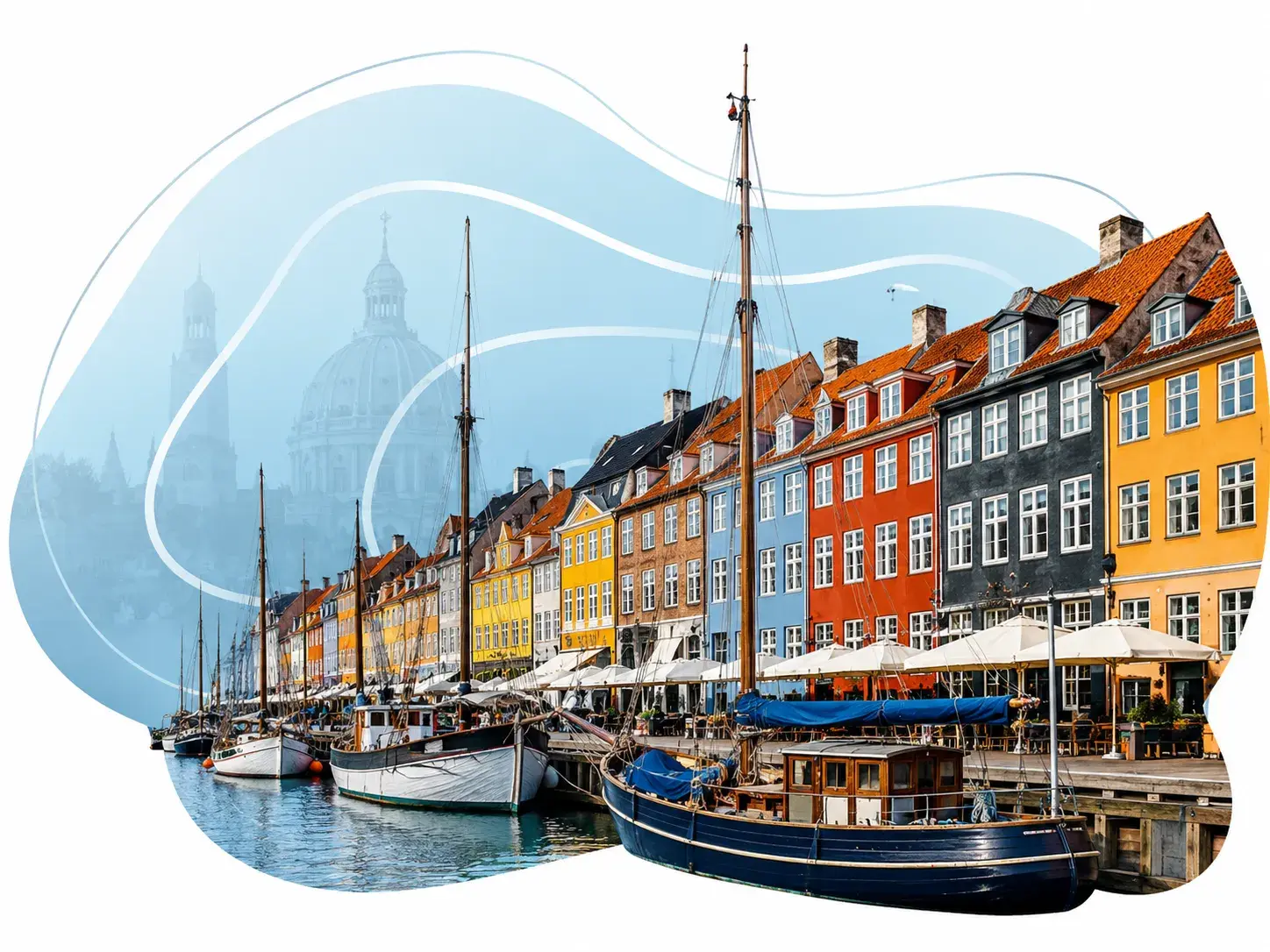
Discover & Hire Top Talents in Denmark
Everything you need to know about the country's employment laws, culture, and workforce insights.

Copenhagen UTC+1 to UTC+2

Copenhagen, Aarhus

Danish Krone (DKK)

Danish, English

monthly is common

Fixed amounts + variable
Talent Landscape in Denmark
Denmark has an estimated labor force of about 3.29 million (2025), with talent demand concentrated in life sciences, clean energy, shipping, technology and design. International employers are most likely to find relevant candidate pools for Life Sciences, Renewable Energy, and Software & Data. The market is well suited to focused hiring, while niche roles benefit from targeted sourcing and a clear employer value proposition. Competition for experienced professionals is typically strongest in technology intensive and regulated functions.
Major Economic Hubs
Copenhagen, Aarhus
Skills In-Demand
Life Sciences
Working Culture
Flat Hierarchy and Employee Voice
Danish workplaces are typically egalitarian, with employees expected to question ideas and contribute regardless of title. Leaders build credibility through competence, openness and fairness rather than status.
Direct Communication with Low Drama
Feedback is usually clear, concise and focused on the issue. Overly emotional or self promotional communication can feel unconvincing.
Trust, Autonomy and Hygge at Work
Employees often receive significant independence and expect reasonable work life balance. Informal social connection matters, but participation should not feel compulsory.
Average Salary
| Job Title | Avg Monthly Salary (DKK) | |
|---|---|---|
| Accounting & Finance | ||
| Administrative Executive, Junior (1-3 years) | 35,100 DKK | S$47,736 |
| Administrative Executive, Mid (3-5 years) | 46,800 DKK | S$63,648 |
| Book Keeper, Junior (1-3 years) | 31,500 DKK | S$42,840 |
| Book Keeper, Mid (3-5 years) | 42,800 DKK | S$58,208 |
| Finance Executive, Junior (1-3 years) | 40,500 DKK | S$55,080 |
| Finance Executive, Mid (3-5 years) | 53,100 DKK | S$72,216 |
| Creatives | ||
| Graphic Designer, Junior (1-3 years) | 40,500 DKK | S$55,080 |
| Graphic Designer, Mid (3-5 years) | 58,500 DKK | S$79,560 |
| UI/UX Designer, Junior (1-3 years) | 42,800 DKK | S$58,208 |
| UI/UX Designer, Mid (3-5 years) | 74,200 DKK | S$100,912 |
| Data Analytics | ||
| Data Analyst, Junior (1-3 years) | 58,500 DKK | S$79,560 |
| Data Analyst, Mid (3-5 years) | 76,500 DKK | S$104,040 |
| Data Engineering | ||
| Data Engineer, Junior (1-3 years) | 58,500 DKK | S$79,560 |
| Data Engineer, Mid (3-5 years) | 94,500 DKK | S$128,520 |
| AI & Machine Learning | ||
| Data Scientist, Junior (1-3 years) | 58,500 DKK | S$79,560 |
| Data Scientist, Mid (3-5 years) | 78,800 DKK | S$107,168 |
| Machine Learning Engineer, Junior (1-3 years) | 49,500 DKK | S$67,320 |
| Machine Learning Engineer, Mid (3-5 years) | 74,200 DKK | S$100,912 |
| Digital Marketing | ||
| Content Marketing, Junior (1-3 years) | 47,200 DKK | S$64,192 |
| Content Marketing, Mid (3-5 years) | 69,800 DKK | S$94,928 |
| Digital Marketing, Junior (1-3 years) | 47,200 DKK | S$64,192 |
| Digital Marketing, Mid (3-5 years) | 69,800 DKK | S$94,928 |
| Growth Marketing, Junior (1-3 years) | 49,500 DKK | S$67,320 |
| Growth Marketing, Mid (3-5 years) | 74,200 DKK | S$100,912 |
| Software Development | ||
| Backend Developer, Junior (1-3 years) | 60,800 DKK | S$82,688 |
| Backend Developer, Mid (3-5 years) | 90,000 DKK | S$122,400 |
| Job Title | Avg Monthly Salary (DKK) | |
|---|---|---|
| DevOps | ||
| DevOps Engineer, Junior (1-3 years) | 58,500 DKK | S$79,560 |
| DevOps Engineer, Mid (3-5 years) | 78,800 DKK | S$107,168 |
| Site Reliability Engineer, Junior (1-3 years) | 58,500 DKK | S$79,560 |
| Site Reliability Engineer, Mid (3-5 years) | 83,200 DKK | S$113,152 |
| Customer Support | ||
| Customer Service Officer, Junior (1-3 years) | 29,200 DKK | S$39,712 |
| Customer Service Officer, Mid (3-5 years) | 38,200 DKK | S$51,952 |
| Customer Experience | ||
| Customer Success Manager, Junior (1-3 years) | 42,800 DKK | S$58,208 |
| Customer Success Manager, Mid (3-5 years) | 60,800 DKK | S$82,688 |
| HR Operations | ||
| HR Executive, Junior (1-3 years) | 38,200 DKK | S$51,952 |
| HR Executive, Mid (3-5 years) | 51,700 DKK | S$70,312 |
| FinTech | ||
| Blockchain Developer, Junior (1-3 years) | 47,200 DKK | S$64,192 |
| Blockchain Developer, Mid (3-5 years) | 69,800 DKK | S$94,928 |
| Payments Engineer, Junior (1-3 years) | 47,200 DKK | S$64,192 |
| Payments Engineer, Mid (3-5 years) | 63,000 DKK | S$85,680 |
| Cloud Computing | ||
| Cloud Engineer, Junior (1-3 years) | 54,000 DKK | S$73,440 |
| Cloud Engineer, Mid (3-5 years) | 78,800 DKK | S$107,168 |
Hiring Guide in Denmark
This guide highlights the fundamental rules employers must know to hire compliantly, covering pay structures, leave policies, termination procedures, and compliance requirements.
For details, browse the topics through the tabs below.
Payroll in Denmark
Payroll Cycle
The pay date follows the employment agreement or collective agreement. Monthly payroll is commonly paid on the last working day.
Minimum Wage
There is no statutory national minimum wage. Minimum pay is mainly set through collective agreements.
Overtime Pay
- Normal hours are generally 37 hours per week under collective agreements. EU rules cap average weekly working time at 48 hours including overtime. - Working-time records and EU daily and weekly rest rules apply.
- Overtime Pay = Ordinary Hourly Rate × Multiplier in the applicable collective agreement or contract × Overtime Hours.
Bonus
13th Month
Denmark does not require a conventional 13th month salary. Employees instead accrue statutory holiday allowance or paid holiday under the Holiday Act, while a year end bonus is contractual or collective.
No statutory 13th month formula. Any separate annual bonus follows the amount or formula in the applicable contract, collective agreement, or binding employer scheme.
Eligibility for holiday pay follows the Holiday Act and the employee’s holiday scheme. A separate 13th month or Christmas bonus is due only under an employment contract, collective agreement, or binding employer practice.
Employees Benefits
| Types of Benefit | Details |
|---|---|
| Mandatory | |
| ATP supplementary pension, occupational injury insurance and statutory holiday allowance | ATP supplementary pension, occupational injury insurance and statutory holiday allowance is the principal mandatory benefit framework for eligible staff in Denmark. The employer is responsible for onboarding the worker with the administering institution, calculating contributions on the legally defined wage base and remitting both shares where employee withholding applies. Exemptions for expatriates, short assignments or specific sectors should be confirmed before payroll starts. |
| Work injury protection under ATP supplementary pension, occupational injury insurance and statutory holiday allowance | Work related accidents in Denmark are handled under the statutory injury provisions associated with ATP supplementary pension, occupational injury insurance and statutory holiday allowance. Employers remain responsible for registration, contribution or insurance costs and timely incident reporting. Eligible workers can receive medical care and cash compensation for incapacity, disability or death according to the local schedule. |
| Statutory termination or end of service entitlement in Denmark | Before ending employment in Denmark, the employer should determine whether the case is redundancy, misconduct, incapacity, contract expiry or ordinary dismissal. That classification controls the required procedure and whether a severance or service indemnity is payable in addition to notice, wages and unused leave. |
| Public healthcare or mandatory medical coverage in Denmark | Health protection in Denmark is delivered through the medical or sickness branch of ATP supplementary pension, occupational injury insurance and statutory holiday allowance. Employers must register employees who meet the scheme’s coverage tests and remit the required payroll contribution on the prescribed wage base. The programme commonly provides medical treatment and cash sickness or maternity benefits, while eligibility for dependants, expatriates and higher earners follows the local institution’s rules. |
| Optional | |
| Supplementary private medical insurance in Denmark | Private medical insurance in Denmark should be designed around the gaps left by ATP supplementary pension, occupational injury insurance and statutory holiday allowance. Employers commonly add faster outpatient access, private hospital treatment, dental, optical, mental health and dependant cover. The policy remains optional unless a visa, emirate, collective agreement or sector rule makes insurance compulsory, and any taxable benefit treatment should be processed through payroll. |
| Performance or profit sharing bonus in Denmark | A performance or profit sharing bonus in Denmark is optional unless promised by contract, collective agreement or an established plan. The rules should specify the performance period, measurable targets, proration for joiners and leavers, and treatment during protected leave. Payroll must apply local income tax and social contribution rules to the payment. |
| Meal, commuting and business travel support in Denmark | Meal, commuting and business travel support in Denmark should be split between fixed cash allowances and reimbursements supported by receipts. That distinction determines whether the amount is taxable salary, exempt expense repayment or part of the contribution wage. The policy should state limits, eligible journeys and the treatment of remote work. |
| Housing, relocation and remote work support in Denmark | Housing, relocation and remote work support in Denmark is normally contractual rather than statutory. The policy should identify covered costs, taxable benefit treatment, repayment conditions for early departure and whether the support is temporary or continues throughout the assignment. |
Taxes
Country Tax
Denmark's country tax is known as Value-Added Tax (VAT) 25%
Individual Tax
| Tax Component | Contribution Rate (%) | Details |
|---|---|---|
| Income Tax Structure | ||
| Resident Tax Rates | Up to about 57%, or about 60.5% including labour market tax | Denmark applies Up to about 57%, or about 60.5% including labour market tax to taxable employment income. The employee’s final liability depends on taxable pay, permitted deductions or credits, and any local surtaxes stated in the cited source. |
| Non-Resident Employment Income | See local nonresident rules | Nonresident individuals are generally taxed only on local source employment income. The applicable rate can differ from resident rates and depends on source, presence, payroll withholding, and treaty relief. Confirm the cited country summary before payroll implementation. |
| Taxable Income Adjustments | ||
| Main Deductions and Allowances | See details | A personal allowance not used by one person may be transferred to the spouse. |
| Taxable & Exempt Components | ||
| Benefits in Kind | Taxable value at marginal rate where applicable | In Denmark, employer provided housing, vehicles, meals, insurance, equity, and other noncash benefits may be taxable under local valuation rules. Business reimbursements and de minimis exemptions require local support. |
| Bonuses and Cash Allowances | Generally taxable at marginal employment rate | In Denmark, cash salary, commissions, performance bonuses, and recurring cash allowances are generally taxable employment income and subject to payroll withholding at the applicable marginal rate unless a specific statutory exemption applies. |
Explore hiring in other countries


























































































































Explore Denmark's Employment Essentials
Glints specializes in Southeast Asia, making us the ideal partner for your expansion. Let's work together to simplify hiring and ensure compliance in Denmark.