


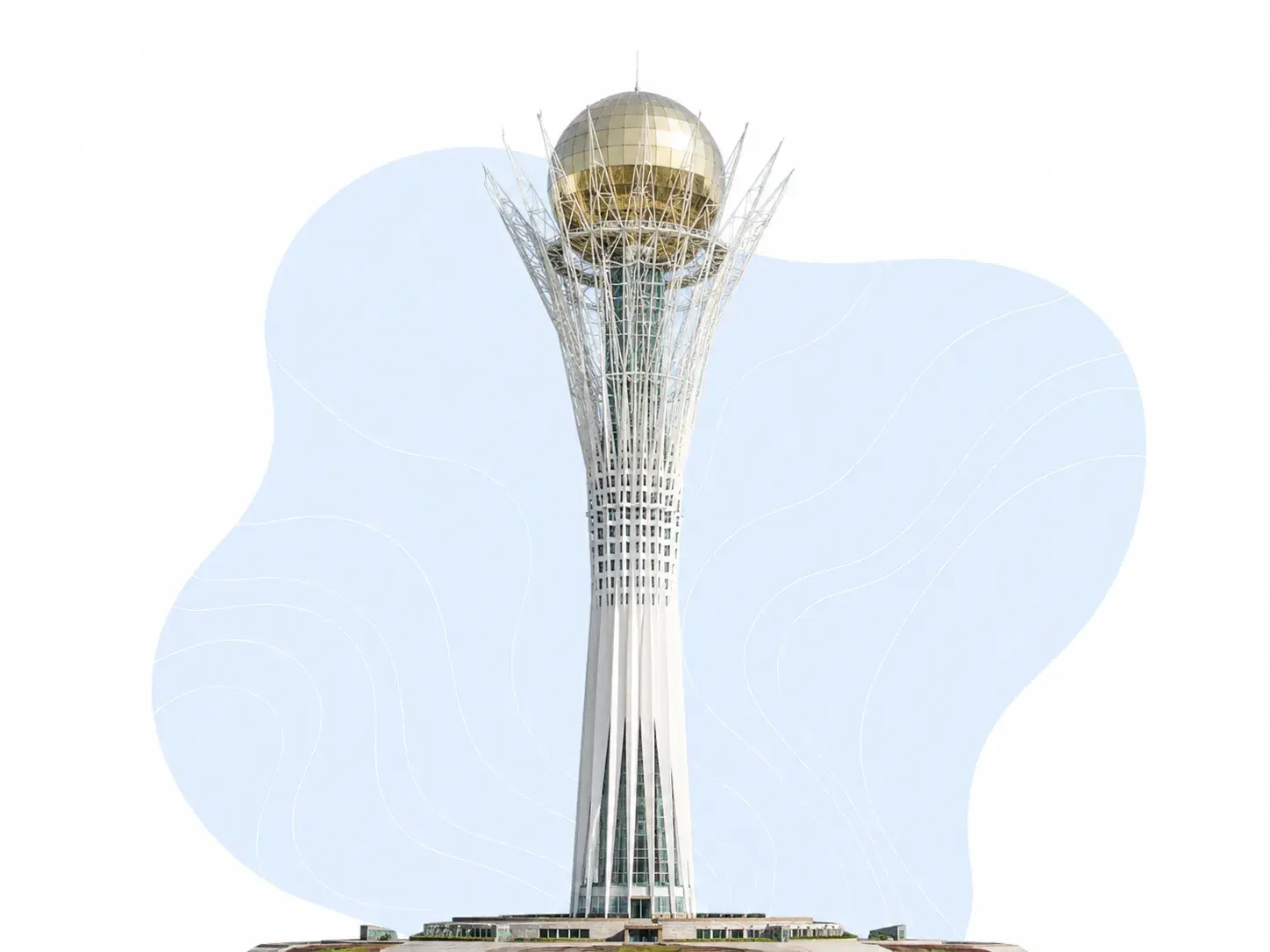
Discover & Hire Top Talents in Kazakhstan
Everything you need to know about the country's employment laws, culture, and workforce insights.

Astana UTC+5

Almaty, Astana, Shymkent

Tenge (KZT)

Kazakh, Russian

monthly

17.50% – 22.50%
Talent Landscape in Kazakhstan
Kazakhstan has an estimated labor force of about 10.0 million (2025), with talent demand concentrated in oil and gas, mining, logistics, financial services and digital services. International employers are most likely to find relevant candidate pools for Mining Engineering, Petroleum Engineering, and Logistics. The market can support focused regional or functional teams, with specialist depth concentrated in the main business centers.
Major Economic Hubs
Almaty, Astana, Shymkent
Skills In-Demand
Mining Engineering
Working Culture
Formal Beginnings, Trusted Relationships
Kazakhstani business relationships often start formally and become warmer as trust develops. Use titles at first, invest in face to face contact and expect personal credibility to influence whether a proposal advances.
Centralised Decisions and Clear Sponsorship
Important decisions may sit with senior leaders, even when technical discussions involve a broader team. Identify the true sponsor, provide concise briefing materials and avoid assuming that meeting participation equals decision authority.
Urban, Regional and Generational Variation
Workplace formality and decision speed can differ between Almaty, Astana and regional operations, as well as between established organisations and younger private companies. Managers should confirm local approval practices instead of applying one national assumption.
Average Salary
| Job Title | Avg Monthly Salary (KZT) | |
|---|---|---|
| Accounting & Finance | ||
| Administrative Executive, Junior (1-3 years) | 400,000 KZT | S$544,000 |
| Administrative Executive, Mid (3-5 years) | 534,000 KZT | S$726,240 |
| Book Keeper, Junior (1-3 years) | 359,000 KZT | S$488,240 |
| Book Keeper, Mid (3-5 years) | 487,000 KZT | S$662,320 |
| Finance Executive, Junior (1-3 years) | 462,000 KZT | S$628,320 |
| Finance Executive, Mid (3-5 years) | 605,000 KZT | S$822,800 |
| Creatives | ||
| Graphic Designer, Junior (1-3 years) | 462,000 KZT | S$628,320 |
| Graphic Designer, Mid (3-5 years) | 667,000 KZT | S$907,120 |
| UI/UX Designer, Junior (1-3 years) | 487,000 KZT | S$662,320 |
| UI/UX Designer, Mid (3-5 years) | 846,000 KZT | S$1,150,560 |
| Data Analytics | ||
| Data Analyst, Junior (1-3 years) | 667,000 KZT | S$907,120 |
| Data Analyst, Mid (3-5 years) | 872,000 KZT | S$1,185,920 |
| Data Engineering | ||
| Data Engineer, Junior (1-3 years) | 667,000 KZT | S$907,120 |
| Data Engineer, Mid (3-5 years) | 1,077,000 KZT | S$1,464,720 |
| AI & Machine Learning | ||
| Data Scientist, Junior (1-3 years) | 667,000 KZT | S$907,120 |
| Data Scientist, Mid (3-5 years) | 898,000 KZT | S$1,221,280 |
| Machine Learning Engineer, Junior (1-3 years) | 564,000 KZT | S$767,040 |
| Machine Learning Engineer, Mid (3-5 years) | 846,000 KZT | S$1,150,560 |
| Digital Marketing | ||
| Content Marketing, Junior (1-3 years) | 539,000 KZT | S$733,040 |
| Content Marketing, Mid (3-5 years) | 795,000 KZT | S$1,081,200 |
| Digital Marketing, Junior (1-3 years) | 539,000 KZT | S$733,040 |
| Digital Marketing, Mid (3-5 years) | 795,000 KZT | S$1,081,200 |
| Growth Marketing, Junior (1-3 years) | 564,000 KZT | S$767,040 |
| Growth Marketing, Mid (3-5 years) | 846,000 KZT | S$1,150,560 |
| Software Development | ||
| Backend Developer, Junior (1-3 years) | 693,000 KZT | S$942,480 |
| Backend Developer, Mid (3-5 years) | 1,026,000 KZT | S$1,395,360 |
| Job Title | Avg Monthly Salary (KZT) | |
|---|---|---|
| DevOps | ||
| DevOps Engineer, Junior (1-3 years) | 667,000 KZT | S$907,120 |
| DevOps Engineer, Mid (3-5 years) | 898,000 KZT | S$1,221,280 |
| Site Reliability Engineer, Junior (1-3 years) | 667,000 KZT | S$907,120 |
| Site Reliability Engineer, Mid (3-5 years) | 949,000 KZT | S$1,290,640 |
| Customer Support | ||
| Customer Service Officer, Junior (1-3 years) | 333,000 KZT | S$452,880 |
| Customer Service Officer, Mid (3-5 years) | 436,000 KZT | S$592,960 |
| Customer Experience | ||
| Customer Success Manager, Junior (1-3 years) | 487,000 KZT | S$662,320 |
| Customer Success Manager, Mid (3-5 years) | 693,000 KZT | S$942,480 |
| HR Operations | ||
| HR Executive, Junior (1-3 years) | 436,000 KZT | S$592,960 |
| HR Executive, Mid (3-5 years) | 590,000 KZT | S$802,400 |
| FinTech | ||
| Blockchain Developer, Junior (1-3 years) | 539,000 KZT | S$733,040 |
| Blockchain Developer, Mid (3-5 years) | 795,000 KZT | S$1,081,200 |
| Payments Engineer, Junior (1-3 years) | 539,000 KZT | S$733,040 |
| Payments Engineer, Mid (3-5 years) | 718,000 KZT | S$976,480 |
| Cloud Computing | ||
| Cloud Engineer, Junior (1-3 years) | 616,000 KZT | S$837,760 |
| Cloud Engineer, Mid (3-5 years) | 898,000 KZT | S$1,221,280 |
Hiring Guide in Kazakhstan
This guide highlights the fundamental rules employers must know to hire compliantly, covering pay structures, leave policies, termination procedures, and compliance requirements.
For details, browse the topics through the tabs below.
Payroll in Kazakhstan
Payroll Cycle
Salary is paid at least monthly, generally no later than the 10th day of the following month.
Minimum Wage
A statutory national monthly minimum wage applies.
Overtime Pay
- Normally 8 hours per day and 40 hours per week. - Maximum overtime is generally 2 hours per day, or 1 hour for hazardous work, with monthly and annual caps.
- Kazakhstan: Overtime Pay = Ordinary Hourly Rate × 1.5 × Overtime Hours. - Apply any separate night, rest-day or public-holiday premium stated in the overtime rates column.
Bonus
13th Month
Kazakhstan does not impose a general statutory 13th month salary on private sector employers. Private sector employees therefore have no automatic entitlement to an additional annual salary unless a binding employment contract, collective agreement, wage order, employer rule, or special sector law provides one.
No statutory private sector calculation applies. Where a binding instrument grants an annual bonus or 13th salary, the amount must be calculated under that instrument; there is no legal default that it equals 1 month of salary.
No private sector employee in Kazakhstan qualifies automatically under the general labour law. Eligibility is limited to employees expressly covered by the applicable contract, collective agreement, wage order, employer rule, or special sector provision. The general law does not prescribe a universal minimum service period, prorating method, payment deadline, or entitlement after resignation or dismissal for a 13th salary. Those points must be determined from the specific binding instrument. Statutory leave pay, severance, end of service benefits, profit sharing, and public sector payments are separate benefits and should not be recorded as private sector 13th month salary unless the local rule expressly treats them that way.
Employees Benefits
| Types of Benefit | Details |
|---|---|
| Mandatory | |
| Unified Accumulative Pension Fund, social insurance and compulsory medical insurance | Employers in Kazakhstan must apply the contribution and registration rules for Unified Accumulative Pension Fund, social insurance and compulsory medical insurance. Payroll should separately identify the employer funded amount and any employee deduction, use the statutory contribution wage or ceiling, and retain evidence of enrolment. The exact branches covered are those listed in the scheme, which can include retirement, health, unemployment or employment injury protection. |
| Work injury protection under Unified Accumulative Pension Fund, social insurance and compulsory medical insurance | Kazakhstan requires employers to protect employees against accidents and occupational disease through the work injury component of Unified Accumulative Pension Fund, social insurance and compulsory medical insurance or a legally approved policy. The obligation includes premium or levy payment, accident reporting and cooperation with medical or disability assessments. Coverage is not replaced by a private medical plan. |
| Statutory termination or end of service entitlement in Kazakhstan | There is no automatic service gratuity for every dismissal. Statutory compensation commonly equals one average monthly wage for liquidation, workforce reduction or certain employer breaches, with higher protection possible under contracts or collective agreements. |
| Public healthcare or mandatory medical coverage in Kazakhstan | Health protection in Kazakhstan is delivered through the medical or sickness branch of Unified Accumulative Pension Fund, social insurance and compulsory medical insurance. Employers must register employees who meet the scheme’s coverage tests and remit the required payroll contribution on the prescribed wage base. The programme commonly provides medical treatment and cash sickness or maternity benefits, while eligibility for dependants, expatriates and higher earners follows the local institution’s rules. |
| Optional | |
| Supplementary private medical insurance in Kazakhstan | Private medical insurance in Kazakhstan should be designed around the gaps left by Unified Accumulative Pension Fund, social insurance and compulsory medical insurance. Employers commonly add faster outpatient access, private hospital treatment, dental, optical, mental health and dependant cover. The policy remains optional unless a visa, emirate, collective agreement or sector rule makes insurance compulsory, and any taxable benefit treatment should be processed through payroll. |
| Performance or profit sharing bonus in Kazakhstan | A performance or profit sharing bonus in Kazakhstan is optional unless promised by contract, collective agreement or an established plan. The rules should specify the performance period, measurable targets, proration for joiners and leavers, and treatment during protected leave. Payroll must apply local income tax and social contribution rules to the payment. |
| Meal, commuting and business travel support in Kazakhstan | Meal, commuting and business travel support in Kazakhstan should be split between fixed cash allowances and reimbursements supported by receipts. That distinction determines whether the amount is taxable salary, exempt expense repayment or part of the contribution wage. The policy should state limits, eligible journeys and the treatment of remote work. |
| Housing, relocation and remote work support in Kazakhstan | Housing, relocation and remote work support in Kazakhstan is normally contractual rather than statutory. The policy should identify covered costs, taxable benefit treatment, repayment conditions for early departure and whether the support is temporary or continues throughout the assignment. |
Taxes
Country Tax
Kazakhstan's country tax is known as Value-Added Tax (VAT) 16%
Individual Tax
| Tax Component | Contribution Rate (%) | Details |
|---|---|---|
| Income Tax Structure | ||
| Resident Tax Rates | Up to 15% | Kazakhstan applies Up to 15% to taxable employment income. The employee’s final liability depends on taxable pay, permitted deductions or credits, and any local surtaxes stated in the cited source. |
| Non-Resident Employment Income | Generally 10% or 15% | The nonresident rate depends on the income category and whether the income is connected with a permanent establishment. Treaty relief may apply. |
| Taxable Income Adjustments | ||
| Main Deductions and Allowances | See details | equal to the amount of social payments, including mandatory pension fund contributions, health insurance contri- butions withheld from an employee’s income, and social secu- rity contributions withheld from the income of individuals providing services under civil contracts Tax deductions may be applied either at source by the tax agent or independently by the individual if they are not applied at source. |
| Taxable & Exempt Components | ||
| Bonuses and Cash Allowances | Generally taxable at marginal employment rate | In Kazakhstan, cash salary, commissions, performance bonuses, and recurring cash allowances are generally taxable employment income and subject to payroll withholding at the applicable marginal rate unless a specific statutory exemption applies. |
| Benefits in Kind | Taxable value at marginal rate where applicable | In Kazakhstan, employer provided housing, vehicles, meals, insurance, equity, and other noncash benefits may be taxable under local valuation rules. Business reimbursements and de minimis exemptions require local support. |
Explore hiring in other countries






























































































Explore Kazakhstan's Employment Essentials
Glints specializes in Southeast Asia, making us the ideal partner for your expansion. Let's work together to simplify hiring and ensure compliance in Kazakhstan.