


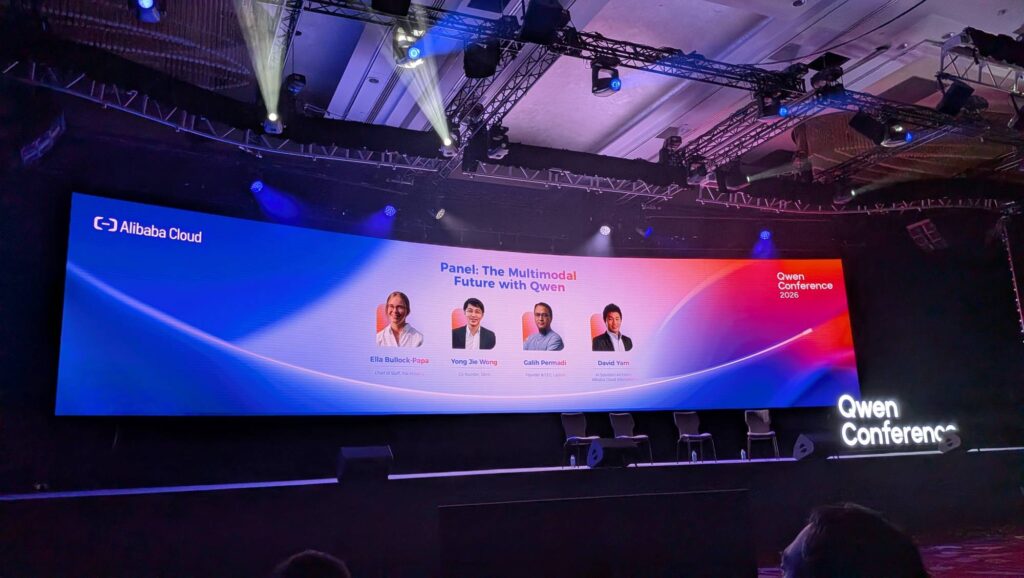
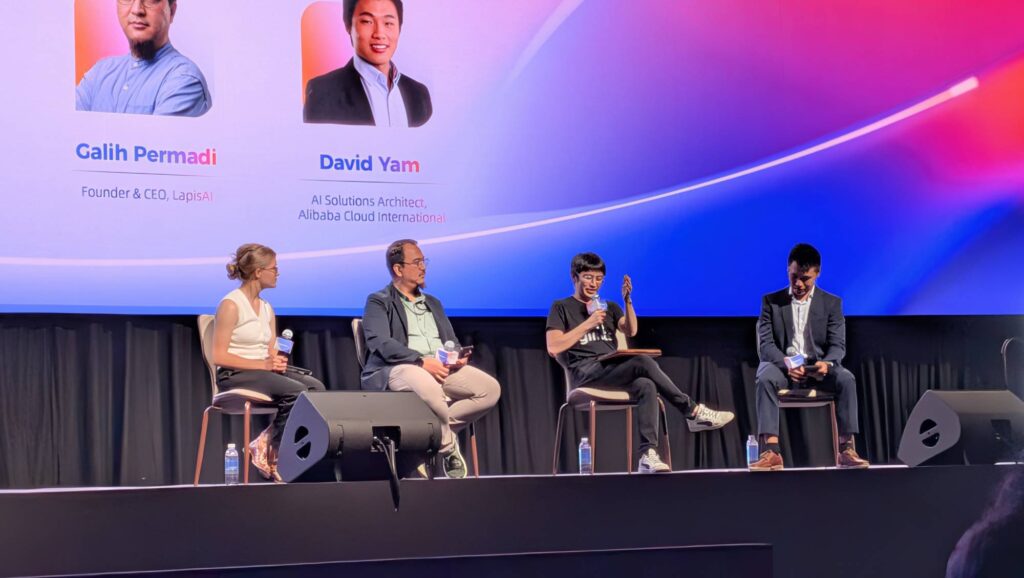
Multimodal AI is moving from experimentation to real-world implementation. In the session “The Multimodal Future with Qwen,” speakers explored how organizations are integrating AI into products, workflows, and daily operations. The discussion covered emerging use cases such as AI-assisted hiring, coding, fraud detection, and workflow automation, while also highlighting challenges around evaluation, user adoption, and data readiness.
As AI takes on more execution-focused tasks, human roles are increasingly shifting toward judgment, system design, and decision-making. The session ultimately outlined a future where AI functions as an always-on teammate that proactively supports business operations.
The Two Things That Break in Production
One of the key lessons from moving AI into production is that the biggest challenges are often not the models themselves, but evaluation and user behavior. Multi-step AI workflows are difficult to evaluate because errors can accumulate across an entire interaction, requiring more sophisticated testing systems than traditional single-prompt evaluations.
User adoption also presents unexpected challenges. New users are often sensitive to delays, making fast response times critical even when more advanced models are available. In addition, users tend to prefer familiar workflows. Rather than replacing existing interfaces with entirely new AI-driven experiences, organizations are finding greater success by embedding AI into familiar processes and introducing changes gradually.
As YC Yeung of Glints noted, two of the biggest bottlenecks in production AI today are robust evaluation systems and users’ existing habits.
Where AI Earns Its Keep And Where It Still Needs a Minder
AI delivers the greatest efficiency gains in repetitive, high-volume tasks. For example, job descriptions that once took employers 20–30 minutes to create can now be generated in seconds. Organizations are also using internal AI agents to answer questions about business metrics, operations, and product data, reducing reliance on manual reporting processes.
AI is also accelerating product development by helping teams implement UI updates, fix bugs, and complete smaller tasks more efficiently. However, human oversight remains essential in areas such as fraud detection, senior-level hiring decisions, and reviewing AI outputs that may sound convincing but contain inaccuracies.
The emerging model is clear: AI handles routine execution at scale, while humans focus on judgment, oversight, and high-stakes decision-making.
“AI does the 80% — and humans now spend their entire day on the 20% that actually matters.”
Humans Move Up the Stack
As AI automates more operational tasks, human value is shifting toward system design, decision-making, and exception handling. Rather than executing workflows, people are increasingly responsible for defining goals, setting standards, and determining when AI should escalate issues.
Many routine processes, such as identity verification, can now be automated, allowing teams to focus on complex cases like fraud detection and high-stakes decisions. As a result, roles centered on repetitive, rule-based work are gradually shrinking, while responsibilities that require judgment, relationship management, and problem-solving remain essential.
The emerging pattern is clear: AI handles the routine majority, while humans focus on the most complex and impactful work.
“AI takes the median work. Humans get pushed to the tails, the hardest cases and the highest-leverage decisions.”
The Barbell Hiring Market
AI-native organizations are not necessarily hiring fewer people, but they are prioritizing different skill sets. Demand is growing for AI-fluent professionals who can work with AI tools, orchestrate workflows, and manage AI-powered teams. At the same time, roles that require strong judgment, trust, compliance, customer relationships, and decision-making remain highly valuable.
Meanwhile, routine execution-focused roles are becoming increasingly automated. Across Southeast Asia, employers are showing greater demand for AI engineers and senior professionals who can lead AI-augmented operations.
The key shift is not headcount reduction, but a move toward talent with stronger systems thinking, judgment, and adaptability.
“AI-native orgs are hiring a different shape of person — more taste, more judgment, more systems thinking. The headcount question is the wrong frame.”
The AI-Native Hiring Platform: An Always-On Teammate
Looking ahead, the hiring platform of the future is expected to function less like traditional software and more like an autonomous teammate. With access to hiring data, candidate information, and company context, AI agents will be able to handle routine recruitment tasks such as job posting, candidate screening, outreach, and interview scheduling.
Rather than waiting for user prompts, these systems will proactively monitor hiring pipelines, identify issues, and surface recommendations when human input is needed. The vision is a shift from reactive tools to AI-powered collaborators that continuously support hiring teams in the background.
“Not just a prompt-operated vending machine — it needs to act on its own clock, not only when prompted.”YC Yeung · Glints
What an LLM Cannot Fake
As AI becomes more integrated into daily work, human skills such as judgment, critical thinking, and domain expertise become even more valuable. The ability to make decisions under uncertainty, evaluate AI-generated outputs, and recognize when AI is wrong remains difficult to automate.
Strong domain knowledge is also essential, as people need enough expertise to guide, supervise, and validate AI-driven workflows. Rather than replacing expertise, AI amplifies the impact of those who can combine deep knowledge with effective use of AI tools.
The key takeaway is that AI raises the value of human judgment and expertise, enabling skilled professionals to achieve greater leverage and impact.
“The skill ceiling rises. AI makes mediocre humans optional — and great humans more leveraged than ever.”
2029: The Boring Substrate
The final question asked what a 2029 panel on this same stage would find surprising. The answer was elegantly counterintuitive: the most surprising development will be how ordinary AI has become.
By 2029, “AI-powered” will sound as unremarkable as “electricity-powered.” The technology will be invisible, ubiquitous infrastructure beneath a generation of products and companies that simply could not have existed before. The interesting conversation will have moved one layer up.