


As more companies expand beyond their home market, two common solutions often come up: Employer of Record and Business Process Outsourcing.
At first glance, both can help businesses operate in another country without immediately setting up a local entity. But they solve very different problems.
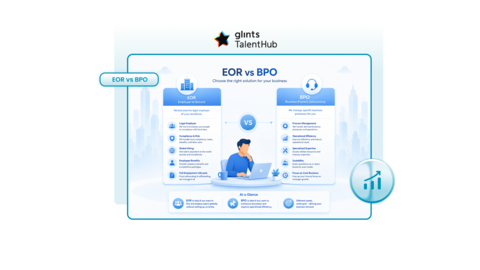
An Employer of Record helps you legally hire, onboard, pay, and manage employees in another country. A Business Process Outsourcing provider helps you outsource a business function, such as customer support, finance operations, IT support, or recruitment operations.
The difference matters because choosing the wrong model can affect hiring speed, compliance, employee experience, operational control, and long term expansion plans.
This guide explains the difference between EOR and BPO, when to use each model, and how employers can decide which option fits their overseas growth strategy.
What Is an Employer of Record?
An Employer of Record (EOR) is a third party organization that legally employs workers on behalf of another company.
This means the EOR becomes the legal employer for compliance, payroll, employment contracts, statutory benefits, taxes, and local employment obligations. The client company still manages the employee’s daily work, goals, performance, and team integration.
For example, a Singapore company may want to hire a software engineer in Indonesia, a customer success specialist in the Philippines, or a marketing manager in Vietnam. Instead of setting up a local entity in each country, the company can work with an EOR to hire the person legally and compliantly.
The EOR handles the employment infrastructure. The company keeps control over the role, team, reporting line, and business outcomes.
What Is Business Process Outsourcing?
Business Process Outsourcing, or BPO, is when a company outsources a specific business function or process to an external provider.
Common BPO services include:
- Customer support
- IT support
- Finance and accounting operations
- Payroll administration
- Recruitment process support
- Data processing
- Sales development
- Back office operations
In a BPO model, the provider usually manages the people, process, workflow, quality control, and service delivery. The client company buys an outcome or operational function rather than directly hiring and managing individual employees.
For example, a company may outsource its customer support team to a BPO provider in the Philippines. The BPO provider may recruit, train, manage, and supervise the support agents. The company receives customer support services, but it may not directly manage each worker as part of its internal team.
EOR vs BPO: The Core Difference
The simplest way to understand the difference is this:
An EOR helps you hire people for your team in another country.
A BPO helps you outsource a business process to another company.
With an EOR, the worker usually functions like part of your internal team. You decide who to hire, what the role does, how performance is measured, and how the person works with your existing team.
With a BPO, you usually buy a service outcome. The provider is responsible for managing the team and delivering the agreed process or function.
This difference affects almost everything, from compliance to control, cost, culture, quality, and scalability.
Key Differences Between EOR and BPO
1. Purpose
EOR is mainly used for global hiring and employment compliance.
It is suitable when you have found the right person in another country and want to hire them legally without opening a local entity.
BPO is mainly used for operational outsourcing.
It is suitable when you want another company to run a function, manage a team, or deliver a repeatable process for you.
2. Employee Relationship
With an EOR, the worker is legally employed by the EOR, but works under your direction. You manage their daily responsibilities, performance, priorities, and collaboration.
With a BPO, the workers are usually managed by the BPO provider. They may support your business, but they are not usually integrated into your company in the same way as direct team members.
3. Level of Control
EOR gives you higher control over the individual employee.
You decide the role, hiring criteria, manager, working style, performance expectations, and career path.
BPO gives you less direct control over individual workers, but more convenience in outsourcing a complete function. The provider usually controls staffing, workflow, training, and process management.
4. Compliance Responsibility
EOR providers take care of employment compliance, including local contracts, statutory benefits, payroll, tax contributions, leave entitlements, and employment regulations.
BPO providers are responsible for delivering outsourced services, but the exact compliance scope depends on the service agreement. If the BPO is employing and managing its own staff, employment compliance usually sits with the BPO provider. However, the client company still needs to manage commercial, data, confidentiality, service quality, and vendor risk.
5. Best Use Case
EOR works best when you want to hire specific talent overseas and keep them close to your internal team.
BPO works best when you want to outsource a function that can be clearly defined, standardized, and measured through service levels.
6. Talent Strategy
EOR is a better fit when talent quality, team integration, and long term capability building matter.
For example, if you are hiring a product manager, senior engineer, finance lead, or regional growth manager, you may want that person to be part of your internal team.
BPO is a better fit when the work can be delivered as an outsourced service.
For example, if you need customer support coverage, finance processing, lead qualification, or administrative support, a BPO provider may be able to deliver the process more efficiently.
7. Speed of Expansion
Both EOR and BPO can help companies expand faster than setting up a local entity.
EOR helps you hire individual employees in new markets quickly.
BPO helps you activate operational capacity quickly by outsourcing a complete process or team.
The better choice depends on whether you need people to become part of your company, or whether you need an external provider to run a function for you.
When Should You Use an EOR?
You should consider using an EOR when you want to hire employees in another country without setting up a local entity.
An EOR may be the right option if:
- You have found a strong candidate overseas and want to hire them quickly.
- You want to test a new market before committing to entity setup.
- You need local employment contracts, payroll, and benefits handled compliantly.
- You want the employee to report directly to your internal team.
- You are hiring strategic roles that need close collaboration with your company.
- You want to reduce the legal and administrative complexity of cross border hiring.
- You need support with onboarding, payroll, leave, benefits, and ongoing employee management.
EOR is especially useful for companies hiring across Southeast Asia, where each country has different employment laws, tax rules, statutory benefits, payroll cycles, public holidays, and termination requirements.
When Should You Use BPO?
You should consider using BPO when you want to outsource a business function rather than directly hire and manage employees.
A BPO may be the right option if:
- You need to scale a repeatable operational process.
- You want a provider to manage staffing, training, workflow, and quality control.
- The function is not core to your internal capability.
- You want predictable service delivery through agreed performance metrics.
- You need faster operational coverage without building a full internal team.
- You are comfortable with less direct control over individual workers.
BPO can work well for functions such as customer support, finance operations, IT support, data processing, lead generation, and administrative tasks.
Can a Company Use Both EOR and BPO?
Yes. Many companies use both models for different needs.
For example, a company expanding into Southeast Asia may use an EOR to hire a country manager, sales lead, or marketing manager. These roles need close alignment with company strategy, culture, and decision making.
At the same time, the company may use a BPO provider for customer support or back office operations, where the work can be managed as a service.
The key is to separate strategic hiring needs from process outsourcing needs.
Use EOR when the person should be part of your team.
Use BPO when the process can be handled by an external provider.
EOR vs BPO for Overseas Hiring
If your main goal is overseas hiring, EOR is usually the more relevant solution.
This is because EOR is built around employment. It helps you hire talent legally in another country, provide compliant employment contracts, run payroll, manage benefits, and support the employee throughout the employment lifecycle.
BPO can support overseas operations, but it is not designed for hiring individual employees into your team. It is designed for outsourcing a business process.
For companies that want to build a distributed regional team, an EOR can provide the structure needed to hire across markets without setting up a local entity in every country.
EOR vs BPO for Control and Culture
Control is one of the biggest differences between EOR and BPO.
With an EOR, the employee can join your meetings, report to your managers, use your internal systems, follow your company goals, and become part of your culture.
This is useful for roles that require trust, context, ownership, and collaboration.
With a BPO, the outsourced team may follow your service requirements, but they are usually managed through the provider’s structure. This can be efficient, but it may create more distance between your company and the people doing the work.
For highly strategic roles, EOR usually gives employers better control and stronger team integration.
For repeatable operational work, BPO can provide scale and process efficiency.
EOR vs BPO for Cost
The cost structure is also different.
EOR costs usually include the employee’s salary, statutory contributions, benefits, local payroll administration, compliance support, and an EOR service fee.
BPO costs usually depend on the outsourced service, headcount model, service level agreement, complexity, volume, and provider margin.
EOR may be better when you want transparency around the cost of hiring a specific person.
BPO may be better when you want to outsource a complete function and manage cost based on service output.
The right choice is not always the cheaper one. It depends on what you need to achieve.
If you need direct talent ownership, EOR is often the better fit.
If you need operational capacity managed by another provider, BPO may be the better fit.
EOR vs BPO for Compliance
Compliance is another important factor.
When hiring employees overseas, companies need to consider employment contracts, working hours, leave entitlement, public holidays, social security, income tax, statutory benefits, termination rules, and local labour requirements.
An EOR is designed to manage these employment obligations.
A BPO provider may manage compliance for its own employees, but it does not necessarily solve the client company’s need to hire and manage individual overseas employees as part of its internal team.
This is why companies should not treat EOR and BPO as interchangeable. They may both support international operations, but they manage different types of risk.
How to Choose Between EOR and BPO
To decide between EOR and BPO, start with the business problem you are trying to solve.
Ask these questions:
1. Do you want to hire a specific person into your team?
If yes, EOR is likely the better fit.
2. Do you want another provider to run a process for you?
If yes, BPO may be the better fit.
3. Do you need direct control over the employee’s daily work?
If yes, EOR gives you more control.
4. Is the work repeatable, standardized, and easy to measure through service levels?
If yes, BPO may work well.
5. Is the role strategic to your company’s growth?
If yes, EOR is often more suitable.
6. Are you testing a new market before setting up an entity?
If yes, EOR can help you hire in market without immediate entity setup.
7. Do you need a managed operational team rather than individual hires?
If yes, BPO may be more practical.
EOR vs BPO: Which Is Better?
Neither model is better in every situation.
EOR is better when you want to hire and manage talent overseas as part of your own team.
BPO is better when you want to outsource a process or business function to an external provider.
For global expansion, many companies need both at different stages.
A company may begin with EOR to hire its first employees in a new country. Later, it may add BPO support for operational functions. Or it may use BPO for support services while using EOR for roles that require stronger ownership and internal alignment.
The best choice depends on your hiring goals, operating model, compliance needs, and how much control you want over the people doing the work.
Why EOR Matters for Companies Hiring Across Southeast Asia
Southeast Asia offers access to strong talent pools across technology, customer support, operations, finance, marketing, and commercial roles. But each market has its own employment rules, payroll requirements, benefits expectations, and compliance obligations.
For employers, this can make cross border hiring complex.
An EOR helps companies hire in Southeast Asia without needing to set up a local entity first. This can be useful for businesses that want to move quickly, test new markets, or build distributed teams across countries such as Indonesia, Vietnam, the Philippines, Malaysia, Thailand, and Singapore.
Instead of managing each country’s employment setup from scratch, companies can work with an EOR partner that supports local hiring, onboarding, payroll, contracts, compliance, and ongoing employee support.
How Glints TalentHub Can Help
Glints TalentHub helps companies source, hire, onboard, pay, and retain Southeast Asian professionals compliantly and at scale.
For companies comparing EOR and BPO, the key question is whether you want to hire talent into your team or outsource an entire function.
If you want to hire specific talent in Southeast Asia without setting up a local entity, Glints TalentHub can support the full employment lifecycle, from talent sourcing and compliant hiring to onboarding, payroll, benefits, and employee management.
This gives you a cleaner path from finding the right person to getting them started, while reducing the complexity of overseas employment.
Final Thoughts
EOR and BPO both help companies expand beyond their home market, but they are not the same.
EOR helps you hire people overseas and manage employment compliance.
BPO helps you outsource business processes to an external provider.
If your priority is building a team across countries, EOR is usually the stronger fit. If your priority is outsourcing a repeatable function, BPO may be more suitable.
For employers hiring across Southeast Asia, understanding the difference can help you choose the right model, reduce compliance risk, and build a more scalable regional workforce.