


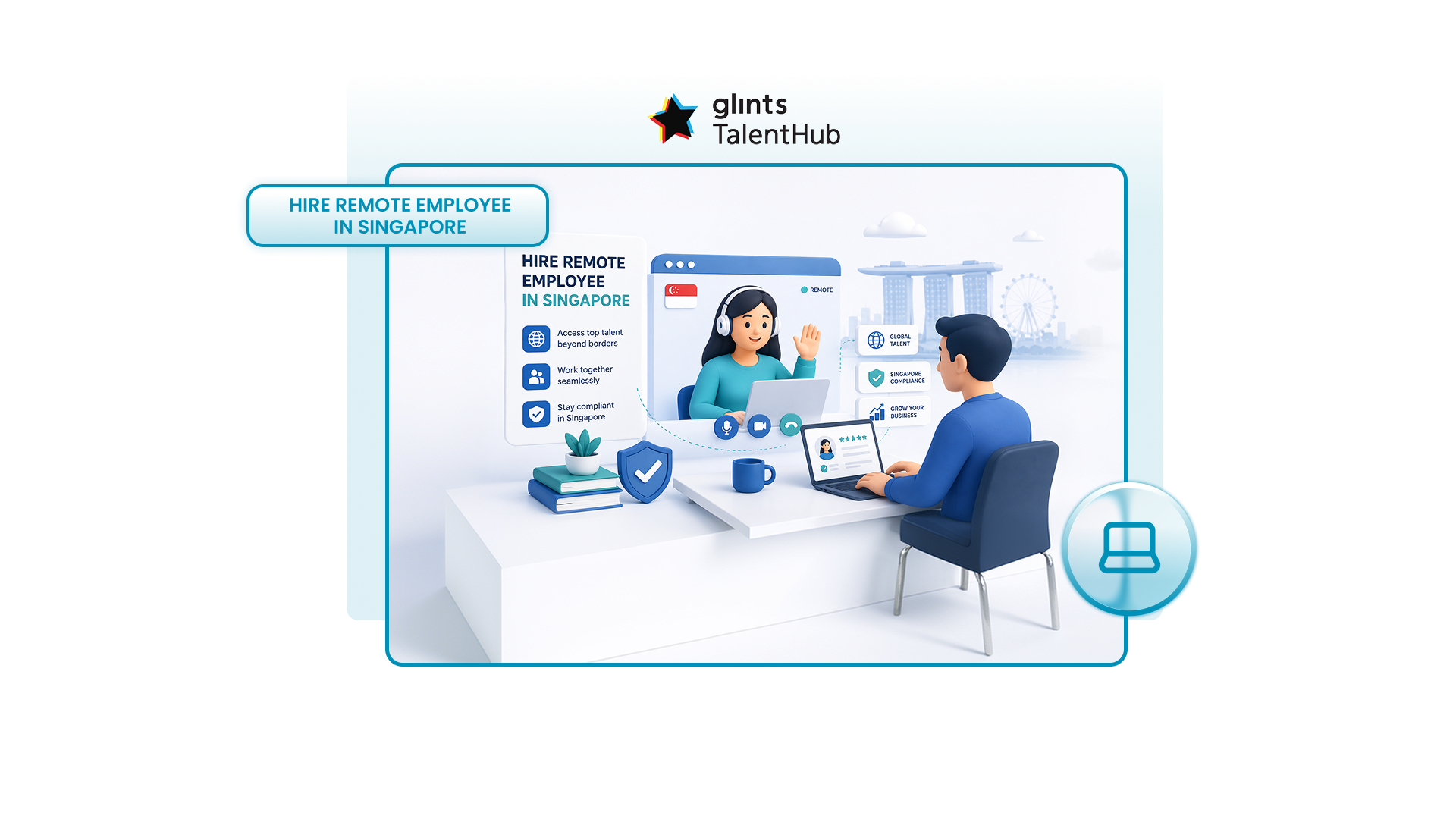
Hiring a remote employee in Singapore can be a smart way to access skilled talent without requiring everyone to work from a physical office. But remote work does not remove employer obligations. If the employee is based in Singapore, employers still need to consider employment law, CPF, tax, work pass rules, payroll, employment contracts, data security, and flexible work arrangements.
Singapore’s remote hiring rules depend on one key question: where is the employee physically working? A Singapore citizen working remotely from home in Singapore is treated differently from a foreign employee who needs a work pass, or a Singapore employee who is posted overseas. Employers should confirm the worker’s location, employment status, and payroll setup before issuing an offer.
What Does it Mean to Hire a Remote Employee in Singapore?
Hiring a remote employee in Singapore usually means one of three scenarios.
First, the employee lives and works in Singapore, but does the job remotely from home or another agreed location. This is common for roles in technology, marketing, sales, customer success, finance, and operations.
Second, a foreign company hires someone who is physically based in Singapore. In this case, the employer must think carefully about local payroll, CPF, tax, and whether it has a proper Singapore employment setup.
Third, a Singapore company hires a remote employee who works from another country. This creates a different compliance question, because local employment, tax, social security, and payroll rules may apply in the employee’s country of work.
The most important rule is simple: remote work changes where the work happens, but it does not remove employment responsibilities.
Is Remote Work Allowed in Singapore?
Yes. Remote work is generally allowed in Singapore, as long as the employment arrangement is properly agreed between employer and employee.
Singapore’s Tripartite Guidelines on Flexible Work Arrangement Requests cover flexible work arrangements, including flexi place, flexi time, and flexi load arrangements. MOM has also clarified that employees may formally request flexible work arrangements, and employers should consider these requests based on business needs.
Employers are not required to approve every remote work request. However, they are expected to assess requests fairly and based on reasonable business grounds, such as job requirements, productivity needs, team coverage, client requirements, operational needs, or the employee’s ability to perform the role remotely.
Step 1: Decide Whether The Person is an Employee or Contractor
Before hiring remotely, decide whether the role should be treated as employment or independent contracting.
A remote employee works under a contract of service. This usually means the employer controls the person’s work, sets expectations, pays salary, provides benefits, and manages performance. MOM states that a contract of service defines the employer employee relationship and should include key terms such as working hours and job scope.
A contractor works under a contract for service. Contractors usually run their own business, decide how the work is delivered, and are paid for a service or project. Statutory employee benefits do not usually apply to contractors.
Misclassifying an employee as a contractor can create risks around salary claims, CPF, tax, benefits, termination, intellectual property, and employer liability. If the person works like an employee, treat the arrangement as employment.
Step 2: Check Whether The Employee Can Legally Work in Singapore
If the remote employee is a Singapore citizen or Singapore Permanent Resident, they can generally work in Singapore without a work pass.
If the person is a foreigner who intends to work in Singapore, they must hold a valid work pass before starting work. MOM states that all foreigners who intend to work in Singapore must have a valid pass, and employers engaging foreigners to work in Singapore must ensure they hold the right pass.
For professional roles, the Employment Pass is commonly used for foreign professionals, managers, executives, and technicians. MOM states that Employment Pass candidates need to earn at least SGD 5,600 per month, with higher salary requirements depending on age and sector.
For skilled workers who do not meet Employment Pass criteria, the S Pass may apply. MOM states that new S Pass candidates need to earn at least SGD 3,300 per month, with salaries increasing progressively by age.
One important point for foreign companies: a Singapore Employer of Record cannot usually sponsor work passes for foreigners to be based in Singapore while working for overseas companies. MOM states that work passes are for foreigners to work for Singapore based companies.
Step 3: Choose the Right Hiring Model
There are three common ways to hire a remote employee in Singapore.
1. Hiring Through Your Own Singapore Entity
This is suitable if your company already has a registered Singapore entity and wants to employ the person directly. Your company manages the employment contract, payroll, CPF, taxes, leave, benefits, payslips, and HR administration.
This model gives more control, but also requires local employment knowledge and ongoing compliance processes.
2. Hiring Through an Employer of Record
An Employer of Record can employ the worker locally on your behalf, manage payroll, issue employment documents, handle statutory obligations, and support onboarding. This is useful if you want to hire in Singapore but do not yet have a local entity.
For Singapore citizens and PRs working in Singapore for an overseas entity, CPF notes that when the person is employed through an EOR, the EOR is the employer and is responsible for CPF contributions.
3. Hiring the Person as an Independent Contractor
This can work for short term project based support where the person is genuinely self employed. It is less suitable when you need fixed working hours, ongoing supervision, company tools, internal reporting, or long term team integration.
For remote roles that are core to your business, employee or EOR arrangements are usually safer than contractor arrangements.
Step 4: Prepare a Singapore Compliant Employment Contract
A remote employment contract should cover more than salary and job title. It should make remote work expectations clear from the start.
Under Singapore employment rules, employers must issue written Key Employment Terms to employees who are covered by the Employment Act, hired on or after 1 April 2016, and employed for 14 days or more. MOM states that these terms must be issued within 14 days after employment starts.
A strong remote employment contract should include:
- Employer and employee details
- Job title, scope, reporting line, and start date
- Work location, including whether the employee may work from home, outside Singapore, or from approved locations only
- Working hours, availability windows, time zone expectations, and meeting cadence
- Salary, payroll date, allowances, bonus eligibility, and CPF treatment
- Annual leave, sick leave, public holidays, and other benefits
- Equipment, software, internet, reimbursement, and return of company assets
- Confidentiality, data protection, intellectual property, and security rules
- Performance expectations, probation, notice period, and termination terms
- Process for requesting changes to the remote work arrangement
Remote work should not be left informal. If expectations are unclear, small issues can become bigger problems around responsiveness, overtime, expense claims, information security, or performance management.
Step 5: Set up Payroll, CPF, and Payslips
Payroll is one of the most important areas to get right when hiring a remote employee in Singapore.
Employers must pay CPF contributions for Singapore citizens and Singapore Permanent Residents who earn more than SGD 50 per month.
From 1 January 2026, CPF contribution rates for Singapore citizens and third year Singapore PRs earning monthly wages above SGD 750 are 37 percent in total for employees aged 55 and below, with 17 percent from the employer and 20 percent from the employee. Rates are lower for older age bands.
Foreign employees are generally not required to receive CPF contributions. CPF states that CPF contributions are exempted for foreign employees.
Employers must also issue itemised payslips to employees covered by the Employment Act. MOM states that payslips should be given together with salary payment, or within three working days if they cannot be given together.
Employers must maintain detailed employment records for employees covered by the Employment Act. MOM states that current employee records should be kept for the latest two years, while former employee records should be kept for the last two years and retained for one year after the employee leaves.
Step 6: Understand Singapore Tax Considerations
Tax treatment depends on where the employee performs the work.
If the employee works in Singapore, income earned from services rendered in Singapore is generally taxable in Singapore. IRAS states that this applies even when the employee works for a foreign employer.
If the employee works outside Singapore, overseas income received in Singapore is generally not taxable, although exceptions may apply. IRAS states that overseas income received in Singapore on or after 1 January 2004 is generally not taxable.
For employers, this means remote work location should be documented clearly. A Singapore based remote worker and an overseas based remote worker can create different payroll, tax, social security, and reporting obligations.
Step 7: Manage Working Hours, Overtime, and Leave
Remote employees are still employees. They remain entitled to applicable leave, salary payment, public holiday, and rest day protections under Singapore employment law, depending on their coverage under the Employment Act.
MOM states that the Employment Act is Singapore’s main labour law and covers local and foreign employees working under a contract of service, with certain exceptions. Part 4 of the Employment Act, which covers rest days, hours of work, and other service conditions, applies only to specific groups, such as workmen earning a monthly basic salary of SGD 4,500 or less and non workmen earning a monthly basic salary of SGD 2,600 or less.
For remote teams, employers should be specific about:
- Standard working hours
- Expected response time
- Overtime approval process
- Public holiday treatment
- Sick leave reporting
- Annual leave approval
- Emergency availability
- Time zone overlap
This protects both the company and the employee. It also prevents remote work from becoming always on work.
Step 8: Build a Remote Onboarding Process
Remote onboarding should be structured, not casual.
A good onboarding process helps the employee understand the company, the role, the team, and how success will be measured. This is especially important when the employee does not learn through daily office interactions.
A simple remote onboarding plan can include:
- Signed employment contract and completed payroll setup before the start date
- Laptop, access cards, tools, and software ready before day one
- Welcome email with reporting line, work schedule, and first week plan
- HR orientation covering leave, payroll, benefits, expenses, security, and remote work rules
- Manager briefing covering role outcomes, success metrics, and first 30 days priorities
- Team introductions and recurring one on one meetings
- Clear documentation for workflows, approvals, and communication channels
The goal is to help the employee become productive quickly without needing to guess how the company works.
Step 9: Protect Company Data and Intellectual Property
Remote work increases exposure to security and confidentiality risks. Employees may access company systems from home networks, coworking spaces, personal devices, or overseas locations.
The employment contract and remote work policy should cover:
- Approved devices and software
- Password and multi factor authentication requirements
- Use of personal devices
- Storage of company files
- Client data handling
- Confidentiality obligations
- Intellectual property ownership
- Return or deletion of company information after termination
- Rules for working from public places or overseas
This is especially important for roles that handle customer data, candidate information, financial information, source code, pricing, payroll, or internal strategy.
Step 10: Create a Remote Work Policy
A remote work policy helps managers apply rules consistently across employees.
Your policy should explain:
- Who is eligible for remote work
- Whether remote work is fully remote, hybrid, or case by case
- How employees request flexible work arrangements
- How managers assess requests
- Required working hours and availability
- Communication norms
- Cybersecurity rules
- Equipment and reimbursement
- Health and safety expectations
- How the arrangement may be reviewed, changed, or withdrawn
This is also useful under Singapore’s flexible work arrangement guidelines, where employers are expected to consider formal FWA requests properly.
Common Mistakes When Hiring Remote Employees in Singapore
Here’s a common mistake that employers should avoid:
1. Treating Remote Work as Informal
Remote work should be written into the employment contract or policy. A verbal agreement may create confusion later around working hours, location, expenses, and performance expectations.
2. Ignoring CPF Obligations
If the remote employee is a Singapore citizen or PR working in Singapore, CPF obligations may apply even if the employee works from home.
3. Hiring a Foreign Worker Without Checking Work Pass Rules
A foreigner working in Singapore needs the right work pass. Remote work does not remove this requirement.
4. Using Contractors for Employee Like Roles
If the person works under your supervision, follows your working hours, uses your systems, and performs ongoing work for your business, contractor classification may not be appropriate.
5. Forgetting Overseas Compliance
If a Singapore company hires someone who works remotely from another country, Singapore rules are only part of the picture. The employee’s country of work may have its own employment, tax, payroll, benefits, and termination rules.
6. Not Defining Work Location
A remote employee who works from Singapore today may later work from another country. That change can affect tax, payroll, insurance, data protection, and employment obligations. Employers should require written approval before employees work from a different country.
Hiring Remote Employees in Singapore Through Glints TalentHub
Hiring remote employees can help you access stronger talent, move faster, and support flexible work. But the setup needs to be clear from the start.
Glints TalentHub helps companies source, hire, onboard, pay, and manage talent across Southeast Asia and beyond. For employers hiring in Singapore or building distributed teams across multiple markets, TalentHub can support employment setup, payroll, compliance, onboarding, and workforce administration through one partner.
This gives your team a cleaner way to manage remote employment without having to coordinate separate vendors for hiring, payroll, compliance, and employee operations.
FAQ about Hiring Remote Employees in Singapore
Can a company hire a fully remote employee in Singapore?
Yes. A company can hire a fully remote employee in Singapore if the person is legally allowed to work and the employment arrangement complies with Singapore employment, payroll, tax, and CPF requirements.
Do remote employees in Singapore need CPF?
If the employee is a Singapore citizen or Singapore PR earning more than SGD 50 per month, CPF contributions are generally required. Foreign employees are generally exempt from CPF contributions.
Does a foreign company need a Singapore entity to hire a remote employee in Singapore?
A foreign company may need a local employment setup to hire and pay a Singapore based employee compliantly. Some companies set up a Singapore entity, while others use an Employer of Record for local employment and payroll support.
Can a foreigner work remotely from Singapore for an overseas company?
Foreigners who intend to work in Singapore must hold a valid work pass before starting work. MOM also states that work passes are for foreigners to work for Singapore based companies, and Singapore EORs cannot apply for work passes for foreigners to be based in Singapore while working for overseas companies.
Are remote employees covered by the Employment Act?
Remote employees working under a contract of service may be covered by the Employment Act, subject to the Act’s coverage rules and exceptions. MOM states that the Employment Act covers local and foreign employees under a contract of service, with certain exceptions.
Should remote work be included in the employment contract?
Yes. The contract should clearly state the work arrangement, approved work location, working hours, reporting line, equipment, expenses, confidentiality, data security, and conditions for changing the arrangement.
Conclusion
Hiring a remote employee in Singapore can help employers access high quality talent while offering greater flexibility. But remote hiring still needs proper structure. Employers should confirm work eligibility, choose the right hiring model, issue a compliant contract, set up payroll and CPF correctly, define work location rules, and manage remote performance with clear expectations.
For companies hiring across Singapore and other markets, compliance can become complex quickly. A unified talent operations partner can help you manage employment, payroll, onboarding, and cross border workforce administration more confidently, so your team can focus on building and scaling the right team.